
Toy Safety Tips: Age Warnings, Safety Marks and Buying Toys Safely
14 August 2012
Most toys sold in the UK are safe, and choosing one should be a pleasure. It still pays to check a few things before you buy, particularly when the toy is a present for somebody else’s child: the recommended age, the safety warnings and who is selling it.
We have sold toys and gifts for babies and children at Born Gifted since 2003, and the questions customers ask us have hardly changed in that time. Is it safe for a baby? Are the paints non-toxic? This guide answers those, explains what the marks on the box do and don’t tell you, and covers the handful of hazards worth knowing about. It is written for parents, and just as much for grandparents, godparents and anyone else buying a toy for somebody else’s child.
Start with the age on the box
If you only check one thing, check the age. It matters most when you are buying for someone else’s child, because you may not know what they can safely play with.
There are two kinds of age label. An age recommendation, such as “5+” or “from 18 months”, helps you choose a toy that suits a child’s stage of development. It can take account of safety as well as how the toy is meant to be used, so it is not something to ignore. A warning is more specific. The words “Warning. Not suitable for children under 36 months”, or the little red circle with a line through a baby’s face and the figures 0-3, mark a safety restriction. It usually means small parts that a baby or toddler could choke on, and the packaging should say what the hazard is.
A warning like that is not a comment on how clever or careful a particular child is. An adult sitting nearby does not cancel it either. Small children put things in their mouths faster than anyone can cross a room.
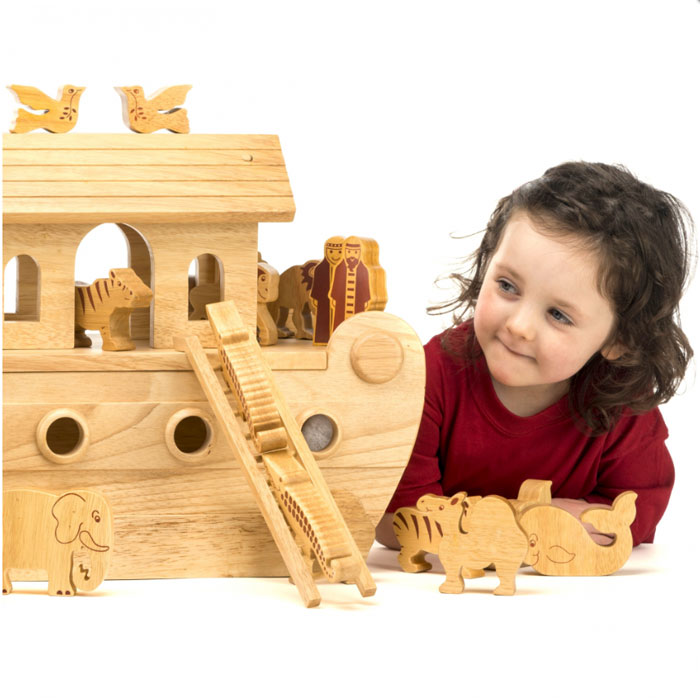
Here is a real example from our own range. We have sold Lanka Kade’s wooden Noah’s Arks as christening presents for more than twenty years, and grandparents in particular love the larger sets. Most of the arks, including the Giant Deluxe Noah’s Ark, are not suitable for children under three because of the small animals.
Buying one for a baby’s christening is fine. Giving it to the baby to play with is not. It goes on a high shelf, to be admired, until the child’s third birthday. It will keep. That is rather the point of a wooden ark.
The same goes for anything described as a christening gift or a new baby gift. The description tells you about the occasion, not the age the toy is safe for. If you are unsure what suits a young child, ask the parents, or choose something clearly made for that age.
What do the CE and UKCA marks mean?
Every toy sold in the UK has to meet the Toys (Safety) Regulations 2011, which cover anything designed for play by children under 14. A toy that meets them carries a mark. In England, Scotland and Wales it can be either UKCA or CE. In Northern Ireland it is CE, sometimes with a UKNI mark beside it, depending on how the toy was assessed.
It helps to know what the mark is. It is the manufacturer’s own declaration that the toy meets the legal requirements. For most toys it is not a certificate from an independent tester, and nobody inspects each toy before the mark goes on. The mark does not make a toy safe: the toy itself has to meet the requirements. On a toy from a known maker, sold by a shop you can trace, that declaration carries weight. On an unbranded toy from an anonymous seller, it may be nothing more than printing.
You may also see “EN 71” in a description. That is the family of safety standards most toys are tested against, covering things like small parts, sharp edges, flammability and the chemicals in paints and plastics.
The Lion Mark, a lion in a red triangle, is different again. It belongs to the British Toy & Hobby Association and can only be used by its members, who sign up to its code of practice. It is a good sign, but it is an industry badge and not a legal requirement, so plenty of perfectly good toys don’t carry it.
Two duller details are worth more than they look. A toy should come with the name and address of its maker or importer, and with its instructions and warnings in English. If you can’t find out who made a toy, that tells you something.
For our part, when we choose toys we look for the CE mark and conformity with EN 71, and we buy from established suppliers, some of whom we have worked with for many years. We do not carry out laboratory testing of our own, and most of our toys are sent to you directly by the people who make or personalise them, but we know that retailers have responsibilities of their own when they supply toys. We would still encourage you to check the age guidance and the warnings yourself, particularly when you are buying for somebody else’s child.
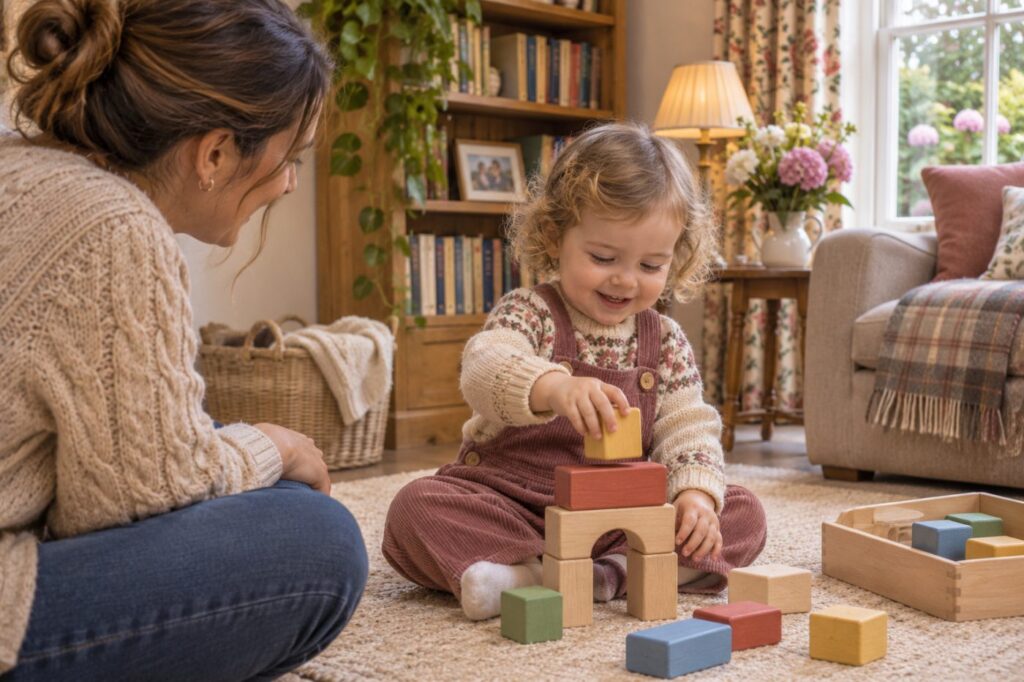
The small things that do the most harm
Some hazards deserve particular attention because the consequences can be serious. None of them is a reason to stop buying toys, but they are worth knowing.
- Small parts: anything a child under three can fit in their mouth is a choking risk, which is why toys made for that age are not allowed to have small or easily detached pieces. Watch older brothers’ and sisters’ toys too. A three-year-old’s playset is very interesting to a crawling baby.
- Ribbons, cords and tags: long cords and loops can catch round a small child’s neck. Decorative ribbons, swing tags and all the packaging should come off before a toy is handed to a baby, as the maker’s instructions will tell you.
- Button batteries: the flat, coin-shaped batteries in some light-up and musical toys can cause severe internal burns if swallowed, and a “dead” one is still dangerous. In a toy, the battery compartment has to be secured, typically with a screw. Check that it is, and keep spare and used batteries well out of reach.
- Small, strong magnets: if a child swallows more than one, they can cause serious injury. A University of Southampton study published in 2025 found that around 300 children and young people a year in the UK end up in hospital after swallowing magnets. Magnetic ball and fidget sets sold for adults are a particular worry in a house with children.
- Water beads: these tiny gel beads can swell to more than 400 times their size in liquid, including inside a child who has swallowed one. The Office for Product Safety and Standards advises keeping them away from children under five altogether, and letting older children use them only under close adult supervision.
- Wear and tear: a safe toy can become an unsafe one. Look now and then for loose eyes, split seams, cracked plastic and splintered wood.
If a child swallows a battery or a magnet
Do not wait to see whether they seem unwell. The official advice is to act fast, even if there are no symptoms.
- Go straight to A&E, or call 999 for an ambulance.
- Do not try to make them sick, and follow the emergency team’s advice about anything to eat or drink.
- Take the toy, the gadget or the packaging with you if you can, but do not let finding it delay you.
If you think a child has swallowed a water bead, get medical help immediately as well, and say what you suspect. Water beads do not show up on an X-ray. The NHS has first aid advice for babies and children, including what to do if a child is choking.

Buying toys online safely
Many of us buy toys online now, and most of the time it works well. The risk is concentrated in one place: unfamiliar third-party sellers on the big online marketplaces, where the company running the website is not the company selling the toy.
In June 2026 the British Toy & Hobby Association published its latest test of marketplace toys. It bought 89 toys from third-party sellers on seven large marketplaces and had them independently tested. Ninety per cent failed UK toy safety requirements: 86% failed a safety test, and a further 4% failed on labelling alone. About two-thirds of the unsafe toys displayed a CE or UKCA mark.
Those figures need reading with care. This was a sample the association chose and bought itself, not a survey of every toy for sale, so it does not mean that nine in ten toys sold online are unsafe. Plenty of marketplace sellers are responsible businesses. What the test does show is that a safety mark in a listing proves very little by itself, and that it pays to know who you are buying from. The government has been consulting on stronger product safety duties for online marketplaces, including clearer requirements to find and remove unsafe products. Whatever rules apply to the platforms, it is sensible to check who is actually selling the toy before you buy.
A few checks make a real difference:
- Find out who the actual seller is, and check that you can trace both the seller and the toy’s maker or importer: a name, a postal address and a way to contact them.
- For a branded toy, compare the listing with the maker’s own website.
- Check that the age warning and the photographs agree. A toy marked for over-threes but pictured with a baby is a warning sign.
- Be wary of a listing with no brand, no age information and no safety warnings.
- When the toy arrives, look it over before you wrap it. The packaging should match the listing and the warnings should be in English, with nothing loose and no battery compartment that opens easily.
Soft toys, babies and sleep
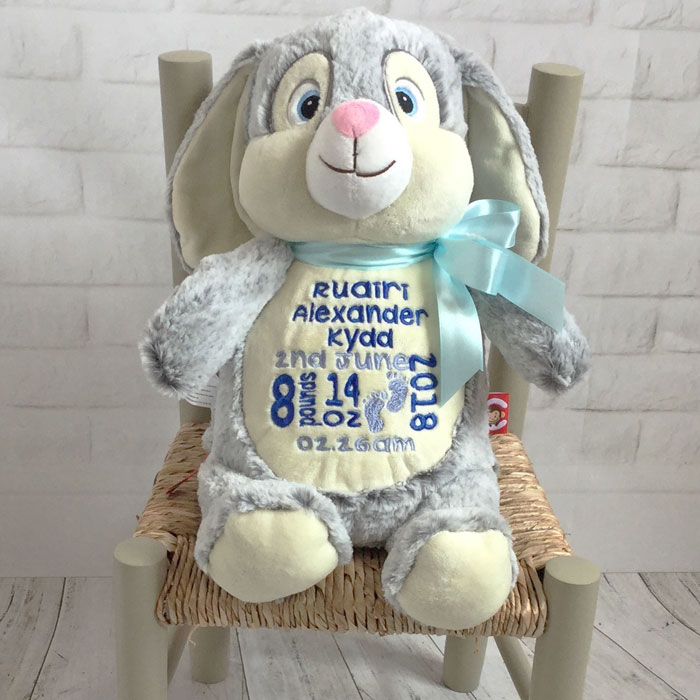
A soft toy is the classic present for a new baby, and many are labelled “suitable from birth”. The Cubbies birth bunny, one of our personalised Cubbies toys, is an example. That label means the toy is designed to be suitable for a baby from birth, provided the maker’s instructions are followed. With our Cubbies bunny, that means taking off the ribbons and tags before you give it to the baby.
It does not mean the toy belongs in the cot. The Lullaby Trust, the safer sleep charity, advises keeping a baby’s sleep space clear for the first twelve months: no soft toys, no comforters, no pillows and no cot bumpers. So a christening teddy or a birth bunny is for cuddles and play when the baby is awake and someone is with them, and for the shelf at sleep time.
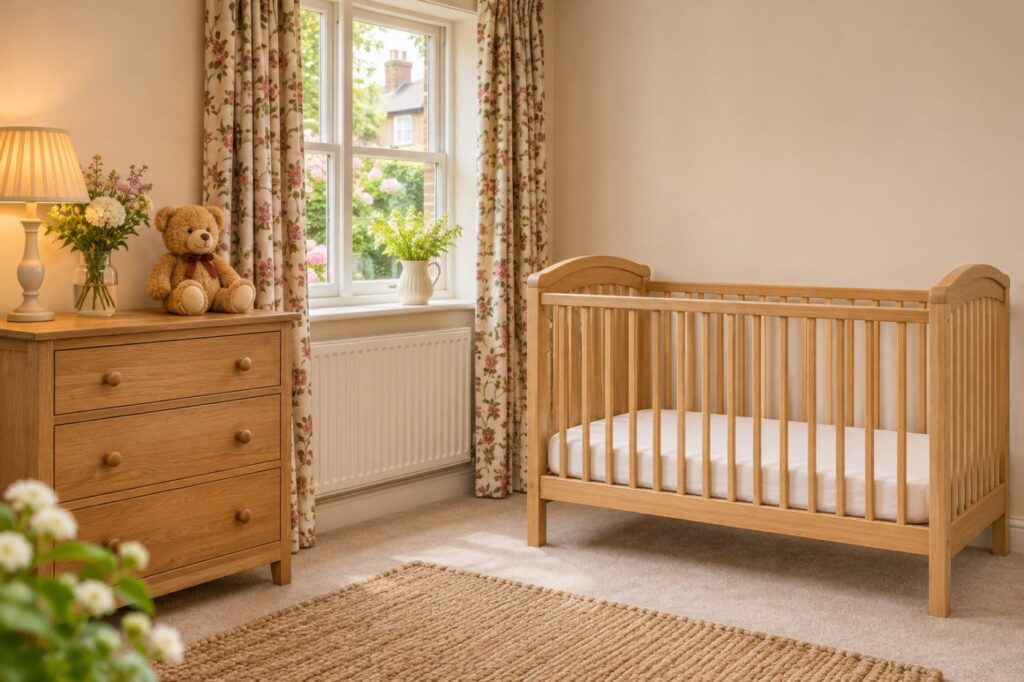
If you are giving a soft toy as a new baby present, it is worth mentioning the safer sleep advice, particularly to anyone else who may be looking after the baby. A teddy can be a lovely present without being part of the sleeping arrangements. Our guide to traditional teddy bears has more on choosing a bear for a baby and on washing one.
Wooden toys, paint and plastics
The questions we are asked most about wooden toys are whether the paint is non-toxic and where the toy was made. On the first, the toy safety rules set strict limits on harmful substances, and that includes what can come out of paints and coatings if a child sucks or chews a toy. Those limits apply to any toy legally sold here, wherever it was made, which is one more reason the maker’s name matters more than the country of origin.
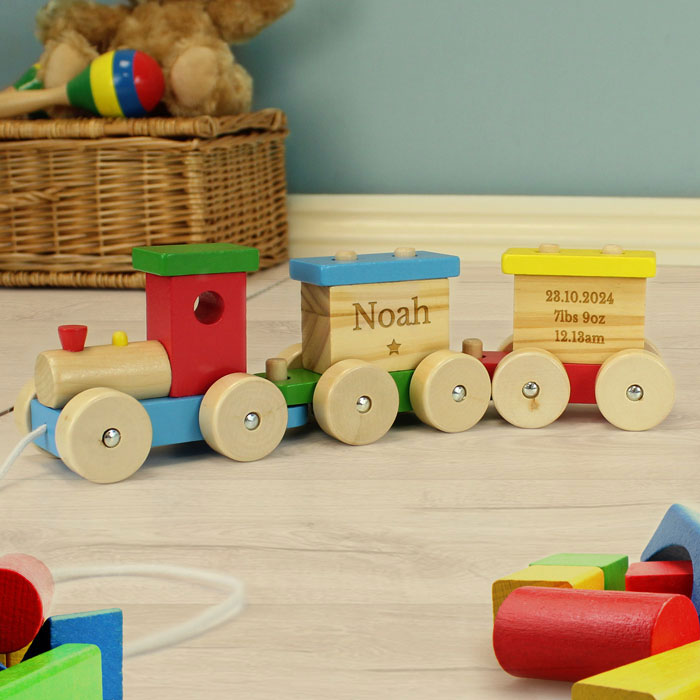
Our Lanka Kade arks are made in Sri Lanka from rubber wood, by a fair trade company we have stocked since we opened, and our guide to fair trade has more about them. Our personalised wooden toy train is for children from 18 months. In each case the age on the listing is the thing to go by.
We are also asked whether things are BPA-free. That question is usually about drinking bottles, cups and tableware, which are not toys and come under separate rules for materials that touch food. It is a fair thing to ask any seller, but it is a different question from toy safety.
Does personalising a toy change anything? Not in our experience. A name embroidered on a bunny or added to a wooden train does not make it suitable for a younger child, or less suitable for an older one. The age guidance stays the same.
Second-hand and hand-me-down toys
We are all in favour of toys being passed on. A good wooden toy that goes through one family’s children and on to the next is exactly what a toy should be, and it is one reason we have always thought of the big Noah’s Arks as heirlooms in waiting.
Old toys still need checking before a child gets them. Look for loose or missing pieces, cracked or splintered wood, weak stitching and flaking paint. Try to find the original age guidance, which the maker’s website will often have even if the box is long gone. The government’s advice on second-hand goods is to make sure the instructions are included, buy from a source you trust and check that the item has not been recalled.
Bear in mind that a toy made decades ago was made to the standards of its day. A much-loved toy that three generations have played with is a lovely thing, but its age is not proof that it is safe for a baby.
If you think a toy is unsafe
Stop using it and put it out of reach. You can search the government’s list of product safety alerts, reports and recalls to see whether that toy has been recalled. If you bought it recently, return it to the seller and say why.
To report an unsafe toy, call the Citizens Advice consumer helpline on 0808 223 1133 in England and Wales, or Advice Direct Scotland on 0808 164 6000. Both pass reports to Trading Standards. In Northern Ireland, unsafe products are reported to your local district council, and Consumerline on 0300 123 6262 can advise you. The government’s guide to reporting an unsafe product explains each route.
A quick checklist before you buy
- Is it right for this child’s age, and does it carry an under-three warning?
- Do you know who is selling it and who made it?
- Does it have a CE or UKCA mark, a maker’s or importer’s address, and instructions and warnings in English?
- Are there small parts, long cords, button batteries or magnets to think about, for this child or for younger ones in the house?
- If it is for a baby, is it clear that it is for daytime and not for the cot?
- If you are not sure, have you asked the parents?
When we first wrote this guide, back in 2012, we said that toys are supposed to be fun, and we still think so. A minute spent reading the box is all that most toys need. After that, the worst you should expect is a child who prefers the cardboard box it came in!