
The Different Types of Bible: Protestant, Catholic, King James and More
21 September 2012
Walk into a bookshop, or search online, and you will find dozens of Bibles: Catholic and Protestant, King James and New International, study Bibles, children’s Bibles, pocket Bibles. If you have been asked to buy one for a christening, a First Holy Communion or a confirmation, or you simply want to know why there are so many, this guide explains the differences in plain English. The first half is about the Bibles themselves and is meant to be useful whoever you are and whatever you believe. The last part is about choosing and personalising one as a gift, which is the bit we know from experience.
Why are there different Bibles?
Two separate questions get muddled together, and most of the confusion about Bibles comes from mixing them up:
- Which books does it contain? Different churches include slightly different sets of books, mainly in the Old Testament. A Catholic Bible has more books than a Protestant one, and an Orthodox Bible more again.
- Which translation is it? The Bible was not written in English. The Old Testament was written mostly in Hebrew, with parts in Aramaic, and the New Testament in Greek, so every English Bible is a translation, and translators make different choices. The King James Version of 1611 and the New International Version of today contain the same books but read very differently.
So “a Catholic Bible” is about the books, and “a King James Bible” is about the translation. You can have a Catholic Bible in a modern translation, and a Protestant Bible in old-fashioned English.
Protestant, Catholic and Orthodox Bibles
All Christian Bibles share the same 27 books of the New Testament. The differences are in the Old Testament:
- Protestant Bibles (Church of England, Methodist, Baptist and most other Protestant churches) have 39 books in the Old Testament, following the Hebrew scriptures, making 66 books in all. The Church of England also uses readings from some of the books known as the Apocrypha, although they are not part of its 66-book canon.
- Catholic Bibles have 46, making 73 books. The seven extra ones are Tobit, Judith, Wisdom, Ecclesiasticus (also called Sirach), Baruch and 1 and 2 Maccabees, and the books of Esther and Daniel are longer. Catholics call these the deuterocanonical books; Protestants call them the Apocrypha. Many Protestant Bibles leave them out, and some print them in a separate section between the Testaments.
- Orthodox Bibles (Greek, Russian and other Eastern Orthodox churches) include the Catholic books and a few more, such as 1 Esdras, 3 Maccabees, the Prayer of Manasseh and Psalm 151, with some variation between the national churches.
None of these is a “wrong” Bible. The churches drew up their lists at different times, from different ancient sources, and each regards its own as complete. If you are buying for someone of a particular church, the safe course is to buy the Bible their church uses.
The Jewish Bible
The Hebrew Bible, or Tanakh, is the scripture of Judaism. It is not simply a renamed Old Testament: it is a collection in its own right, with its own order and its own tradition of reading. It has 24 books in three parts, the Torah (the five books of Moses), the Nevi’im (the Prophets) and the Ketuvim (the Writings), and the Twelve Minor Prophets count as a single book. The same writings appear, in a different order and divided differently, as the 39 books of the Protestant Old Testament.
Other Bibles you may come across
Jehovah’s Witnesses, who identify as Christians, use their own translation, the New World Translation of the Holy Scriptures, published by the Watch Tower Society and last revised in 2013. Other churches do not use it.
The Church of Jesus Christ of Latter-day Saints (often called the Mormon church) uses the King James Version as its official English Bible, read alongside its other scriptures, including the Book of Mormon.
The King James Version and the modern translations
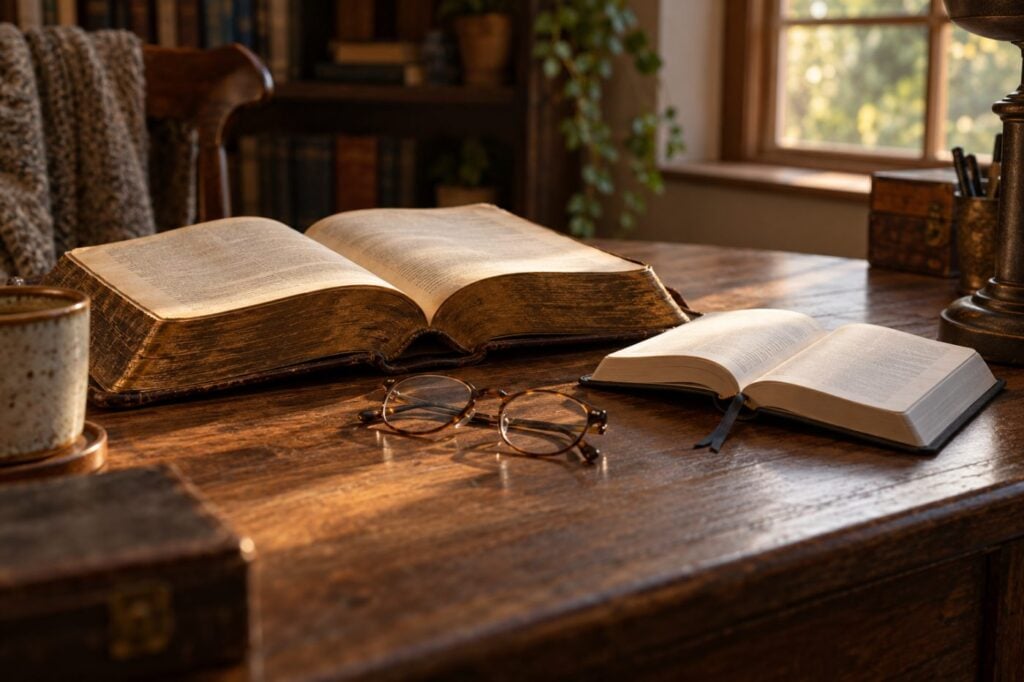
The King James Version (also called the Authorised Version) was commissioned by James I at the Hampton Court Conference in 1604 and published in 1611, the work of about fifty scholars in six companies. It is the Bible of “thee” and “thou”, of the Christmas readings and the words carved on war memorials, and it went on to have an enormous influence on the English language, literature and Christian worship for centuries. Its language is beautiful and, for a modern reader, not always easy. One detail worth knowing: the 1611 edition included the Apocrypha, in a separate section; most King James Bibles printed since the nineteenth century leave it out, so a King James Bible today is normally a 66-book Protestant Bible.
Modern translations go back to the Hebrew and Greek and put them into today’s English. The best-known are the New International Version (NIV), widely used in British churches of many kinds; the English Standard Version (ESV), which keeps closer to the original wording; the New Revised Standard Version (NRSV), common in universities and in Anglican churches; the Good News Bible, written in simple everyday English and long used in schools; the New Living Translation (NLT), which uses accessible modern English; and The Message, a much freer, conversational rendering that many people read alongside a more conventional translation. There are also Catholic editions of several of these, with the full 73 books, and the Jerusalem Bible family, which many Catholics in Britain grew up hearing at Mass.
The quickest way to see the difference is to read the same verse from the different editions. Here is Matthew 19:14, which is read at many christenings:
King James Version: “But Jesus said, Suffer little children, and forbid them not, to come unto me: for of such is the kingdom of heaven.”
New International Version (NIV): “Jesus said, ‘Let the little children come to me, and do not hinder them, for the kingdom of heaven belongs to such as these.'”
Same verse, same meaning, four centuries apart. (“Suffer” in 1611 meant “allow”.) Neither is better; it depends on who is reading and why.
What Catholic churches in England and Wales read at Mass
Since Advent 2024 the readings at Mass in England and Wales have come from a new Lectionary based on the English Standard Version, Catholic Edition, with the Abbey Psalms and Canticles for the psalms, replacing the Jerusalem Bible readings that had been used for about fifty years. That is the book the reader uses at the front of the church; it does not mean every Catholic has to own that translation, and Catholic Bibles in other translations remain in everyday use.
Which Bible is right for the person?
Start with who will use it and how, not with the cover:
- A baby or small child, as a keepsake: a traditional full Bible, often the King James Version, which the child will grow up with and return to. Nobody expects a baby to read it on the day.
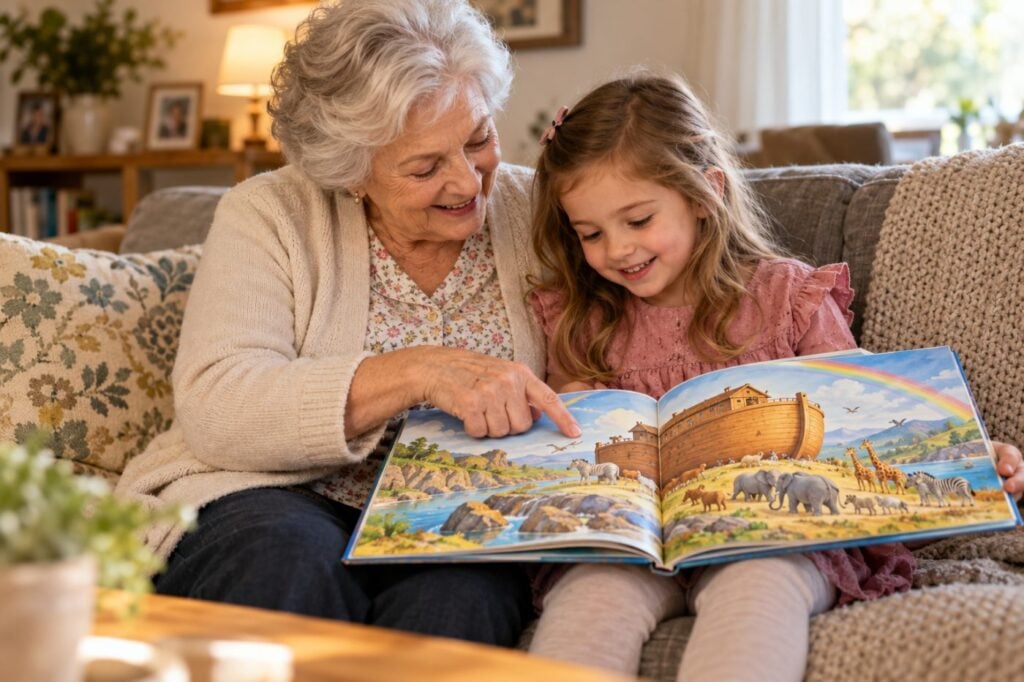
- A child who is starting to read: an illustrated book of Bible stories, with pictures and simple language, or a children’s edition of a modern translation such as the Good News Bible or the NIV. A full King James Bible may be rather difficult for a young reader, however lovely its cover.
- A teenager or an adult new to the Bible: a modern translation (NIV, NLT or Good News) in a readable size, or a study Bible if they want to go deeper. A study Bible contains explanatory notes, maps and other background information alongside the text, for readers who want to explore passages in more detail.
- Someone being confirmed or receiving First Holy Communion: ask the family or the parish whether they have a preferred edition. For a Catholic child that usually means a Catholic Bible, with the 73 books, in whichever translation the family likes.
- Someone of another faith or tradition: ask which edition they would prefer. A Jewish reader, for example, may prefer a Jewish edition of the Tanakh rather than a Christian Bible.
Then think about the physical book: a large-print edition for anyone with poor eyesight, a pocket size for someone who travels, a hard cover for a keepsake, a soft cover for a Bible that will be carried about and read.
Personalised Bibles as gifts
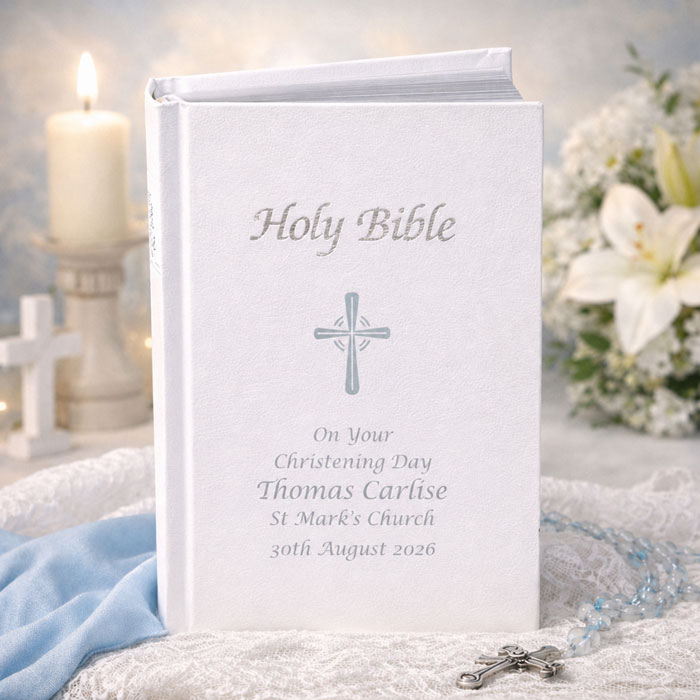
A personalised Bible is a traditional christening present, and a popular one for First Holy Communion and confirmation too, usually from a godparent or grandparent. Ours have the child’s name and the occasion printed on the cover, so the book is theirs from the first day and there is no mistaking whose it was in years to come.
Our bestseller by some distance is the personalised white King James Christening Bible: a full Bible, Old and New Testaments, with a white cover printed with the child’s name, the occasion, the church and the date. It is bought for christenings and First Holy Communions alike, and it has the reviews to show for it.
We also sell a lower-priced range of eco-friendly Companion Bibles, with pages made from recycled paper. They are the same King James text; the difference is the book itself. They are thinner than our traditional presentation Bibles, although some are larger in height and width, and the covers and presentation vary, so it is worth checking the dimensions and photographs of each product before choosing. Some customers choose them for the recycled paper alone; others prefer the more substantial feel of the presentation Bibles.
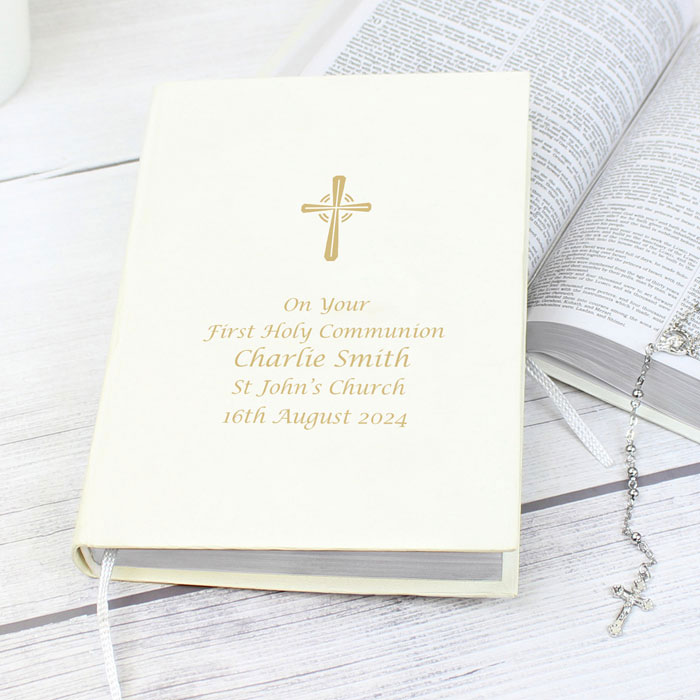
Two things we would rather you knew before you buy than found out afterwards:
- Every full Bible we sell at the moment is the King James Version. That is a Protestant Bible of 66 books, not a Catholic edition. If you are buying for a Catholic child and the family wants a Catholic Bible, our King James editions are not the same thing, and you would do better to look elsewhere for the Bible and perhaps come to us for the keepsake.
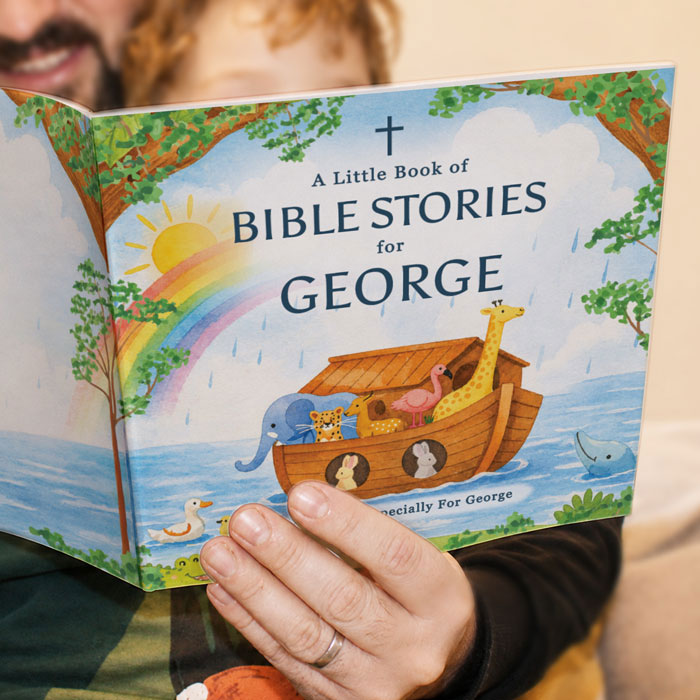
- A “children’s” cover does not mean children’s words. Some of our Bibles have covers designed for children, with a Noah’s Ark or a pink or blue cross, but inside is the full King James text, in traditional language and fairly small print. They are keepsakes to grow into. For a young child who wants to look at pictures and hear the stories now, an illustrated Bible stories book is usually a better starting point. We recently added a personalised illustrated Bible stories book to our range, and it is beginning to prove popular.
What to put on the cover
Most customers keep it traditional, and the layout they choose most is:
On Your
Christening Day
Oliver James Smith
St Mary’s Church
15 June 2027
with “First Holy Communion” or “Confirmation” in place of “Christening” as the occasion needs. The child’s name is the part that matters most, then the occasion and the date; the church is optional, and some families prefer a short message from the godparents or grandparents on the last line. You do not have to fill every line just because the product allows it. Each Bible has its own layout and character limits, so follow the instructions on the product page, and go easy on capital letters: some of the decorative fonts look their best in ordinary capitalisation rather than all upper case. Check the spelling of the name, the church and the date before you order, because a personalised cover cannot be changed afterwards.
Our number-one tip
Don’t worry about giving a full, traditional Bible at a baby’s christening. The baby isn’t going to read it that day, or that year; the point is that it is kept, and that one day they pick it up and find their own name and the date they were welcomed into the church. But if you are buying for a child who is beginning to read, an illustrated storybook or an easier translation will be opened far sooner. And if you are buying for a First Holy Communion or a confirmation, ask whether the family or the church has a preferred edition, especially if the child is Catholic. Choose the Bible for the person who will receive it, not for the nicest cover.
If the occasion is new to you, our guides to christenings, First Holy Communion and confirmation explain what happens on the day and what people usually give.
View our personalised Bibles and christening gifts →
Scripture quotations marked NIV taken from the Holy Bible, New International Version Anglicised. Copyright © 1979, 1984, 2011 Biblica. Used by permission of Hodder & Stoughton Ltd, an Hachette UK company. All rights reserved. ‘NIV’ is a registered trademark of Biblica UK trademark number 1448790. The King James Version quotation is from the Authorised Version, rights in which are vested in the Crown in the United Kingdom.