
What to Do When Your Pet Dies: Practical Help and Support in the UK
30 October 2026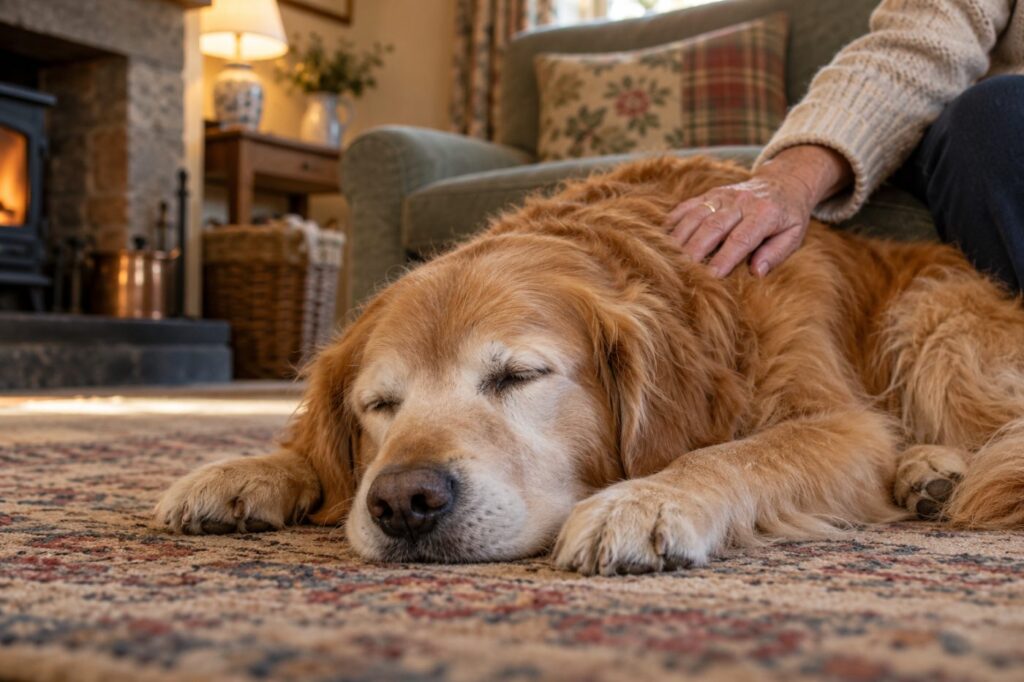
If you are not sure whether your pet has died, or they are unresponsive, ring a vet now. Every practice has an out-of-hours number on its answerphone. Everything else in this guide can wait until you have done that.
Losing a pet is one of the hardest things many of us go through, and it often arrives with a list of practical questions at the worst possible moment: who to call, what to do with their body, whether you can bury them in the garden, what cremation involves, and how to tell the children. We have sold personalised gifts since 2003, helped many customers remember a pet, and lost pets of our own, so we have put this guide together in the order you are likely to need it: the first hours first, then the decisions, then the grief, and only at the very end a few words about remembering them. Last fact-checked: 30 October 2026.
What to do first if your pet has died
If your pet has died, contact your veterinary practice for advice on what happens next. You do not have to make every decision at once, and the practice can explain the options for cremation, burial and keeping your pet’s body in the meantime.
If your dog or cat dies at home
Ring your usual veterinary practice. If it is closed, the recorded message will give you an emergency number, and the out-of-hours vet can tell you whether things can wait until the morning or whether someone can collect your pet sooner. The practice may be able to keep your pet’s body in cool conditions and arrange cremation or collection for you, or you can contact a pet crematorium directly.
If you need to keep your pet at home for a few hours, lay them somewhere cool, out of direct sunlight and away from other animals and small children. You may want to wrap them in a blanket or towel. In warm weather, ask the vet or crematorium how soon they should be moved; do not assume a body can wait at home for a set number of hours.
If you have no idea why your pet died, particularly if you suspect poisoning or an infectious illness, mention it to the vet before you arrange a burial or cremation. They may suggest a post-mortem examination, and it affects whether a garden burial is sensible (more on that below).
If your pet dies at the vet’s
Ask the practice what happens next before you leave. They can keep your pet’s body while you decide, arrange a cremation through the crematorium they use, or let you take your pet home. If you would like a paw print or a clipping of fur as a keepsake, ask straight away; many practices will do this, but it has to happen before your pet is transferred to the crematorium. The RSPCA’s advice on saying goodbye and the PDSA’s guide to the same subject both set out the options clearly.

If your pet dies away from home or on the road
Road traffic law treats dogs and cats differently, and it surprises people. In England, Wales and Scotland a driver who hits a dog, horse, cow, pig, goat, sheep, donkey or mule must stop and give their details, and must report the collision to the police if they cannot; GOV.UK sets out the rule. Cats are not on that list, so there is no duty to report hitting a cat for its own sake (there may be for other reasons, such as damage or injury to a person), which is why so many cat owners never find out what happened. If an animal is injured, getting it to a vet safely comes before anything else. If you find a cat that has been killed on the road and it is safe to do so, take it to a vet to be scanned for a microchip so the owner can be told; the council will usually collect animals from the road, but you cannot rely on every council scanning them.
If your own cat has gone missing, ring the local vets, the council and your microchip database, and ask whether any cats have been brought in. It is a miserable job, but it is often how owners get an answer.
Knowing when it may be time to say goodbye
Many pets do not die naturally at home. For many owners the end involves a hard decision about euthanasia, made together with the vet when an animal’s quality of life is going. The vet’s job is to assess your pet’s welfare and help you understand the options, so you are not deciding alone, but the questions the vets suggest are a good place to start: are they in pain that cannot be controlled; are they still eating, drinking and able to move about; can they keep themselves clean; do they still want to be with you and do the things they enjoyed; and are the bad days now outnumbering the good ones? The PDSA’s quality-of-life questions are worth reading with the whole family. Talk to your vet early rather than late; sometimes there is treatment that helps, and sometimes the kindest thing is to let them go before they are suffering. Choosing that is not letting your pet down.
What happens when a pet is put to sleep
If you would rather not read about the procedure itself, skip to the next section. The vet will talk the decision through with you and ask you to sign a consent form. A nervous animal may be given a light sedative first. The vet then gives an injection, usually into a vein in a front leg, which brings on unconsciousness within seconds and then stops the heart. It is quick and painless. Afterwards your pet’s eyes may stay open, they may take a gasping breath or twitch; the vets are clear that these are reflexes after death, not signs of distress, but it helps to know in advance so they do not alarm you.
Whether you stay in the room is your choice. Some people need to be there; some cannot bear it and say goodbye beforehand; some stay for the sedation and step out for the injection. There is no right answer and you should not feel guilty either way. Many vets will also come to your home for a planned euthanasia, though not every practice offers it and it is rarely possible in an emergency. Costs vary a great deal between practices, and between a surgery appointment, a home visit and an out-of-hours call, so ask for a written estimate that separates the euthanasia itself from any travel, collection, cremation and return of ashes.
When we lost one of our own pets, the thing that helped most was arranging for the vet to come to the house at a time we had agreed in advance. It gave the family a chance to gather, spend some time together and say our goodbyes in familiar surroundings. It was still awful, but having that time together at home somehow made it more bearable for us. We paid extra for the home visit, and felt it was worth every penny. We know it is not possible for everyone, and some families would rather have the support of the practice around them. If it is an option and you would prefer it, though, it is worth asking.
Cremation or burial?
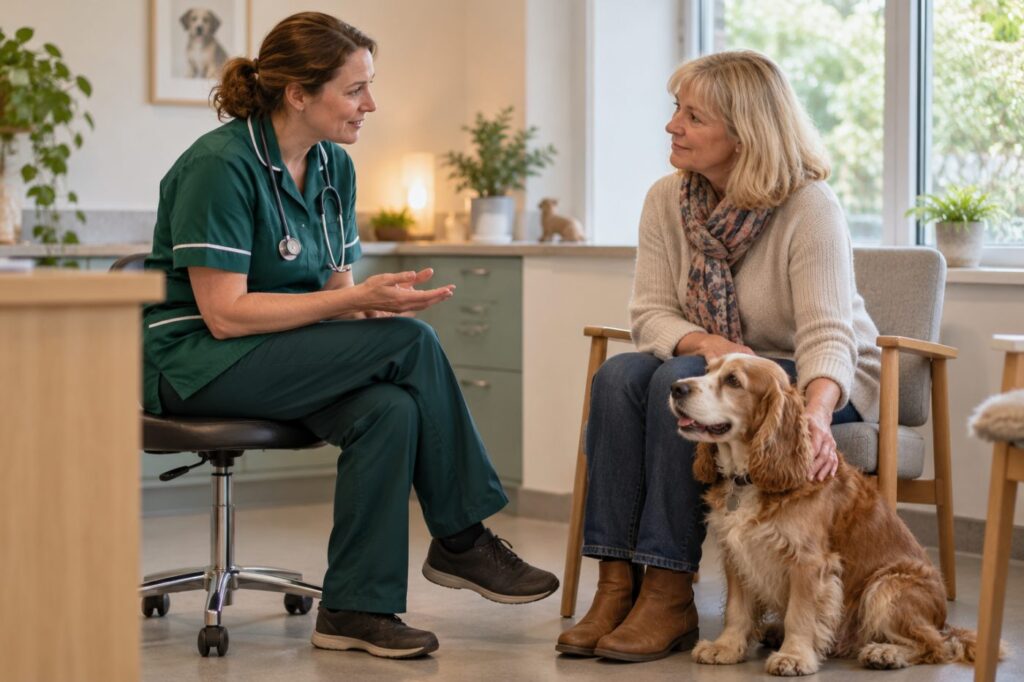
You will usually be offered cremation through the vet, but you do not have to accept the practice’s arrangement. You can choose your own crematorium, a pet cemetery, or, for most dogs and cats, a burial at home. Vets will hold your pet’s body while you decide.
Individual and communal cremation
Cremation is the most common choice, and the first thing to understand is the difference between the two kinds. In a communal cremation, several pets are cremated together and the ashes are not returned to you; the crematorium should be able to tell you what happens to them, which is often scattering or burial at the crematorium’s own grounds, but ask rather than assume. In an individual cremation, your pet’s ashes are collected and returned to you, usually in a simple container, and you can choose a casket or urn or scatter them somewhere that mattered to them.
Even the word “individual” needs a question or two, because practices differ. The trade body for independent pet crematoria, the Association of Private Pet Cemeteries and Crematoria, holds its members to a definition under which the animal is alone in the cremator and the ashes are collected before the next cremation begins, but not every provider works to that standard. Before you agree to anything, it is reasonable to ask:
- Where will my pet be taken, and who will carry out the cremation?
- Will they be the only animal in the chamber?
- How is their identity tracked from collection to the return of the ashes?
- What exactly is included in the price, and is collection, a container or delivery extra?
- Can I visit, or bring my pet to the crematorium myself?
Prices vary with the size of the animal, the type of cremation and where you live, and they change, so we have not quoted any. A quick phone call to two local crematoria will tell you more than any website.
Can I bury my dog or cat in the garden?
In most cases, yes, provided it is your own garden. The rules are a little different in each part of the UK, and a lot of what you will read online about “four feet deep by law” is a mixture of good practice and myth, so here is what the official guidance actually says.
- England: the Environment Agency says you can bury a small domestic pet such as a dog or a cat on your own land, including your back garden, without permission, and that its groundwater distance rules do not apply to small pets. Larger animals such as a pet horse are different; see GOV.UK’s animal burial guidance.
- Wales: Natural Resources Wales says the same: no permission needed for a small pet on your own land, and no groundwater requirements to follow.
- Scotland: the Scottish Government’s authorisation for burying dead pets allows burial on the premises where the animal lived, provided scavenging animals cannot get at the remains and there is no risk to health or the environment. Scotland’s waste rules were moved to a new framework in November 2025, so if you are in any doubt, ask SEPA or your vet.
- Northern Ireland: DAERA’s guidance gives the same exemption, with the same condition, for the garden of the property where the pet lived.
The practical advice is the same everywhere. Bury your pet on land you own (if you rent, ask the landlord first), well away from any watercourse, well, drain or buried pipes and cables, and deep enough that foxes and other animals cannot reach them: the PDSA recommends a grave at least a metre (about four feet) deep, which is good advice rather than a legal minimum. Wrap them in something that will break down, such as a cotton blanket or a cardboard box, rather than plastic. Two situations call for a word with the vet first: if your pet was put to sleep, because the drugs used can be harmful to wildlife that digs them up, and if they died of an infectious disease or had chemotherapy recently, when the vets advise against home burial altogether. If you have no garden, or think you may move house and would find it hard to leave them behind, cremation or a pet cemetery may suit you better. Pet cemeteries are regulated separately; ask about the cost of the plot, who maintains it and whether you will always be able to visit.

The practical things to remember afterwards
None of this is urgent, and most of it can wait a week or two, but it is a list people are grateful for later.
- The microchip database. Ask the database that holds your pet’s chip to mark them as deceased; most let you do it online. Dogs must be microchipped across the UK, and since 10 June 2024 cats in England must be too, so the record will otherwise sit there indefinitely.
- Pet insurance. Tell the insurer. Some policies pay towards euthanasia or a modest sum on death, and you may still be able to claim for recent treatment; cremation is often excluded.
- The vet. Ask them to close the record so you do not get vaccination and worming reminders through the post.
- Subscriptions. Food deliveries, medication, insurance direct debits, the dog walker, the groomer, the cattery booking.
- Registrations. If your dog was Kennel Club registered, or your pet was registered with a breed society, let them know.
Coping with the loss of a pet
Grief for an animal is grief. It can bring shock, sadness, guilt, anger and a loneliness that catches you out at odd moments: the empty basket, the lead by the door, the habit of looking down as you come in. Some people feel it before the death, when they know a decision is coming. Others are surprised by how hard it hits them, and then feel they are not supposed to be this upset “over a pet”. You are. For many people a dog or cat was the one who was always there, and Cruse points out that a pet’s death can also reopen grief for a person they were connected with.
There is no timetable and no set of stages to work through. Talk to people who understood what your pet meant to you, keep to whatever routine you can, and do not let anyone tell you that you should be over it by now. If weeks go by and you are not sleeping, not eating or not coping with ordinary life, speak to your GP.

Free pet bereavement support in the UK
- Blue Cross Pet Loss Support: free and confidential, by phone on 0800 096 6606, by email, by webchat and through a Facebook group, 8.30am to 8.30pm every day of the year. Details on the Blue Cross Pet Loss Support page.
- Cats Protection’s Paws to Listen: a free, confidential listening service for anyone grieving a cat, on 0800 024 94 94, Monday to Friday 9am to 5pm, with a call-back if the line is busy. See the Paws to Listen page.
- Samaritans: if you need to talk to someone at any hour, 116 123.
Our own guide to what to do when someone dies covers grief in more depth; not all of it applies to a pet, but the parts about looking after yourself do.
Helping children when a pet dies
For many children a pet’s death is their first experience of death at all, and how it is handled stays with them. Child Bereavement UK’s advice is to be honest and to use the real words: say the pet has died, or is dead, rather than that they have “gone to sleep”, “gone away” or been “lost”. Small children take these phrases literally; a child told the dog has gone to sleep may be afraid to go to sleep themselves, and one told the cat was lost may wait for it to be found. Answer their questions simply and truthfully, without more detail than they ask for.
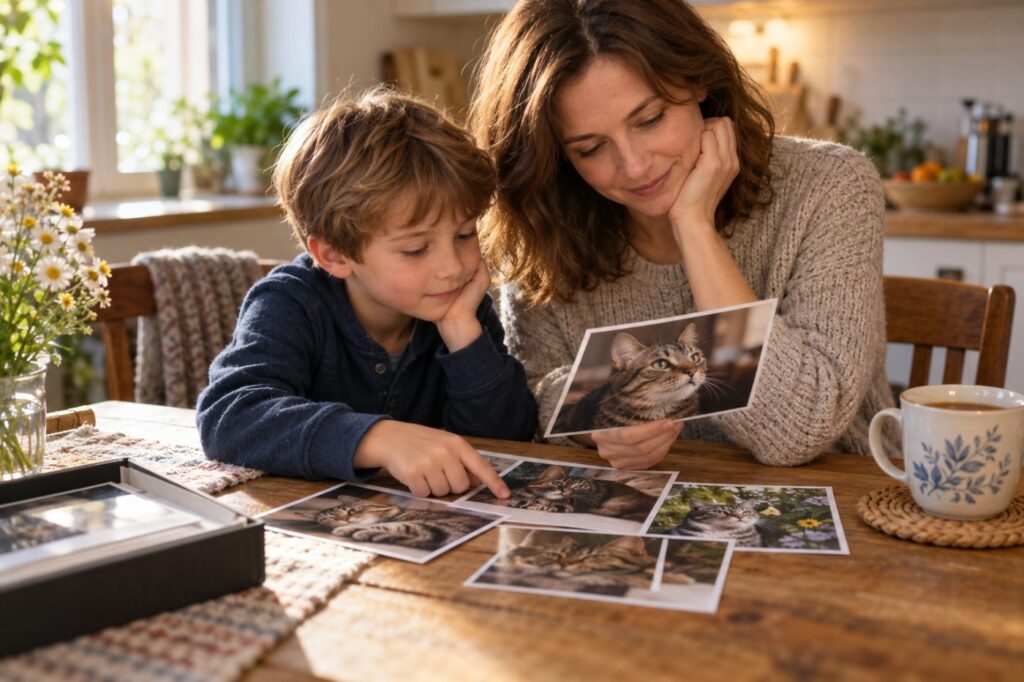
Let them take part if they want to. Children can choose a photograph, draw a picture, write a letter to put in the grave, help plant something, or make a memory box of the collar and a favourite toy (our memory box guide has ideas that work just as well for a pet). Some children cry; some carry on as if nothing has happened and then ask about it weeks later. Neither is wrong. It is worth telling the school or nursery, so that a wobble in class is understood.
How other pets may react
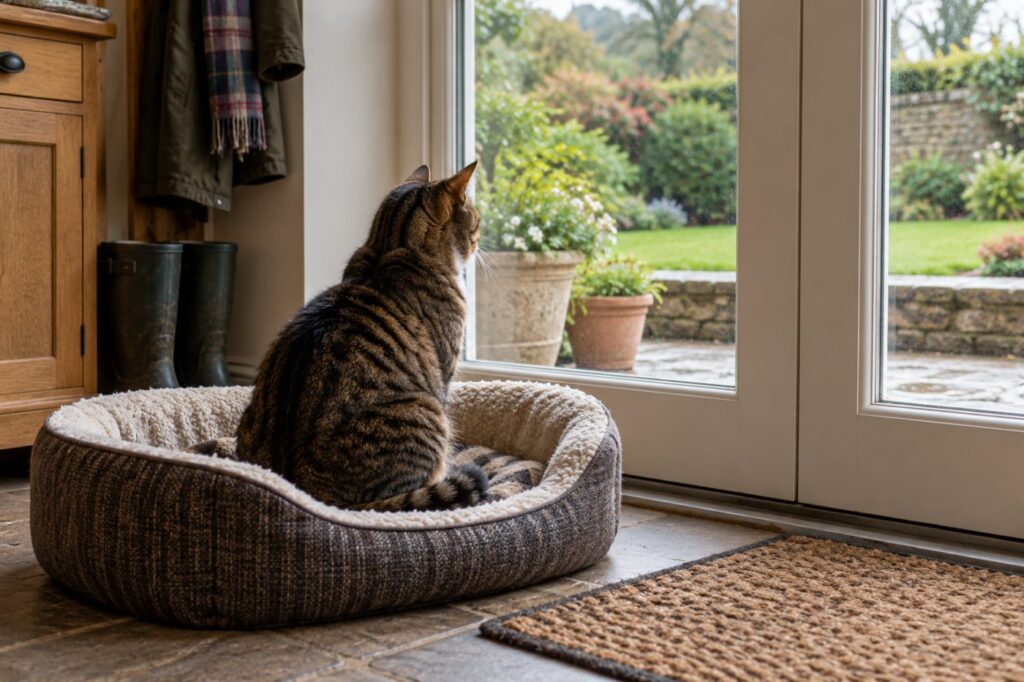
A surviving dog or cat often behaves differently for a while: searching the house, going off their food, calling, following you about, or hiding. Nobody can say for certain what they understand, but routine helps, so keep walks and mealtimes as they were and let them come to you for comfort rather than fussing over them. You will read advice that the surviving animal should be shown the body; there is no good evidence either way, so do what feels right to you. If a surviving pet stops eating or drinking, seems unwell or changes in a way that worries you, ring the vet rather than putting it down to grief; a cat that has not eaten for 24 hours should be seen promptly. And do not get another dog or cat straight away purely to keep the first one company; a new arrival is a stress in itself. Rabbits are the exception, because they live in pairs and a bereaved rabbit may need a new companion sooner, introduced carefully.
Getting another pet
There is no right time. Some people need a house with an animal in it and are ready within weeks; some take years; some decide they are done. Nobody else’s timetable matters, and a new pet is not a replacement for the old one, which is worth saying out loud to children who may worry that it is. If your pet died of something infectious, ask the vet whether you should wait, or do anything to the house, before another animal comes in.
Ways to remember your pet
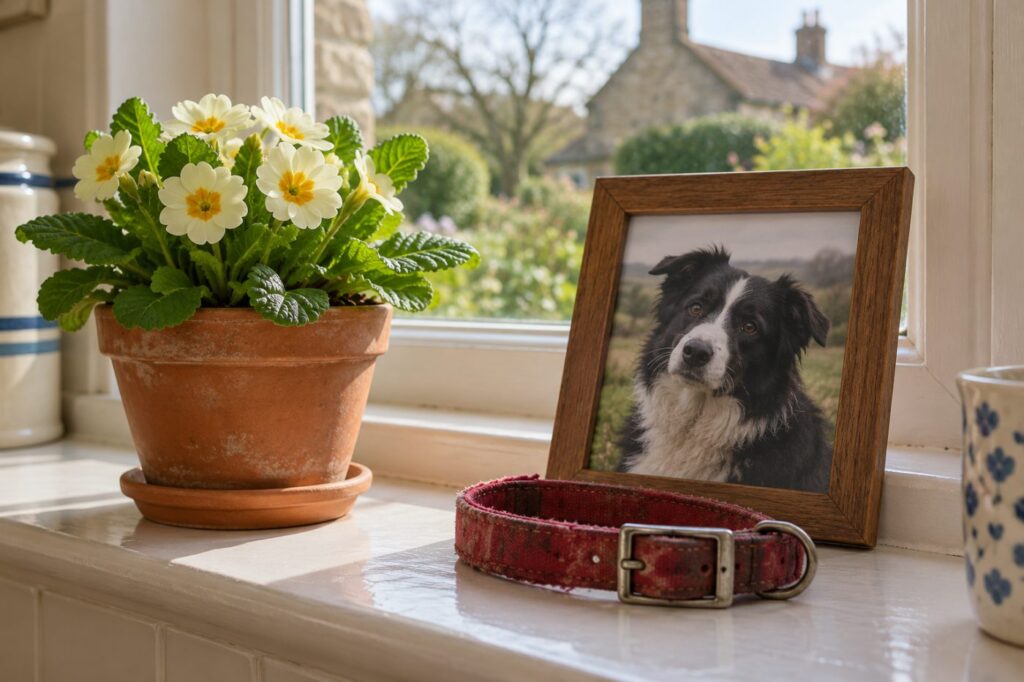
Most of the things that help cost nothing. Choose the photograph you love best and have it printed. Put the collar, the name tag and favourite toy into a box. Walk the usual route once, on your own. Plant something in the garden. Give a few pounds to a rescue in their name. Hold a small goodbye with the family, if that feels right. Many people also find comfort in the idea of the Rainbow Bridge, a short piece of writing about a meadow where pets wait to be reunited with their owners. It circulated anonymously for decades, and it was only in 2023 that an art historian traced it to Edna Clyne-Rekhy, who wrote it in Scotland in 1959, at nineteen, after the death of her Labrador, Major; National Geographic tells the story.
What to write in a pet sympathy card
Short and sincere is best. Use the pet’s name, say you are sorry, and if you knew them, mention something you remember. Three plain examples:
- “I’m so sorry about Max. I know how much he meant to you, and I’m thinking of you.”
- “I was so sad to hear about Bella. If you want to talk about her, I’m here.”
- “No need to reply. I just wanted you to know I’m thinking of you and remembering Charlie and his tennis ball.”
Avoid assuming they share your beliefs about where pets go. And do not make it about the time you lost yours. A card and a practical offer, whether that is dropping round for a cup of tea, picking up some shopping or simply listening, often means more than any present.
Personalised keepsakes, and a word of advice before you order one
Born Gifted has sold personalised gifts since 2003, and over the years we have helped a great many customers choose a keepsake for a pet, so this is the part we know something about. Most are bought by owners for themselves, usually a photo keepsake, because they have the photographs. Friends and relatives buy them as sympathy gifts, and we have had orders from dog walkers and from veterinary practices wanting to mark the loss of a client’s pet, which says something about how much these animals are loved. We get more memorial orders for cats than for dogs, and plenty for rabbits, guinea pigs and hamsters, the occasional horse, and once a lizard. Anything without paw prints on it will do for any animal, and if you want the wording to mention a particular kind of pet, ask us.
If you are buying for yourself, our honest advice is not to rush. We have seen customers make mistakes with names, dates and even delivery addresses when ordering in the first day or two after a loss, when everything is raw, and a memorial is something you will keep for years. Give yourself a little time to choose the photograph, settle on the wording and check it through. There is no deadline for remembering them. When you do order, keep the personalisation simple: a name and the year is often enough, and it is what most of our customers choose, though some like a longer line such as “See you at the Rainbow Bridge” or “Forever leaving pawprints on our hearts”. For the photograph, pick a clear, well-lit picture that shows the whole animal with a little space around it, because photographs almost always need cropping to fit the shape of the product, and a tight close-up leaves us nothing to work with. A picture of you together can be lovely on a larger item; on a small glass token it may not fit. Use the best original you have rather than a screenshot or a small social media copy, and if there is a problem we will usually get in touch before we make anything.
If you are buying for a friend, keep the words plainer still. Messages such as “We will miss you” sound odd coming from someone who was not the owner; a name and a date, or a photograph on its own, say everything, and you do not need to spend much. Most of our gifts can be sent straight to the person with gift wrapping, and where a product has no wrapping option (the small glass tokens, for example) we will write a short message on a compliments slip if you ask.
One more thing, about urns. Our personalised wooden urns are small keepsake urns, about 465 ml, which suits a cat or a smaller dog but not every breed, and the question we are asked most is “will my dog’s ashes fit?” Ask the crematorium how much space the ashes will need rather than guessing from your pet’s weight. Some owners of larger dogs keep a portion in the urn and scatter the rest somewhere that mattered (with the landowner’s permission if it is not your own land), and some use the urn for a collar and tag instead. The urns are not fully sealed, so ashes go in a sealed bag first.
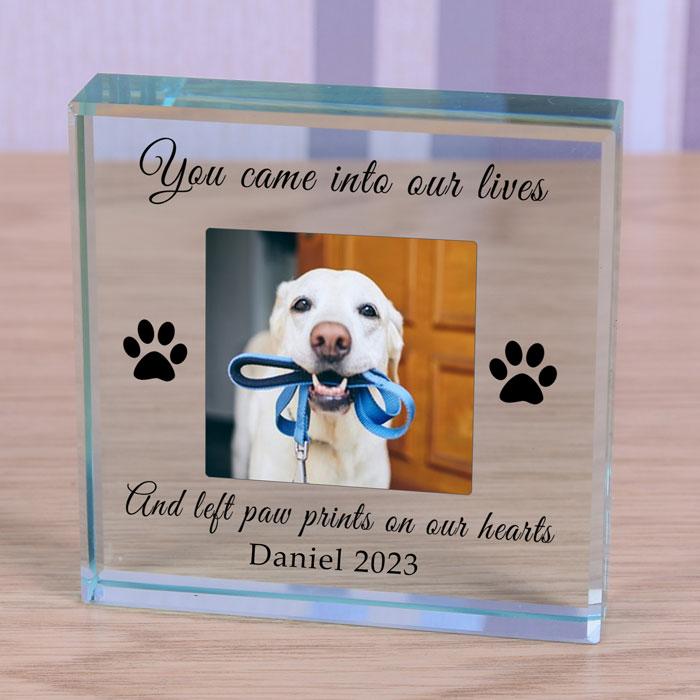
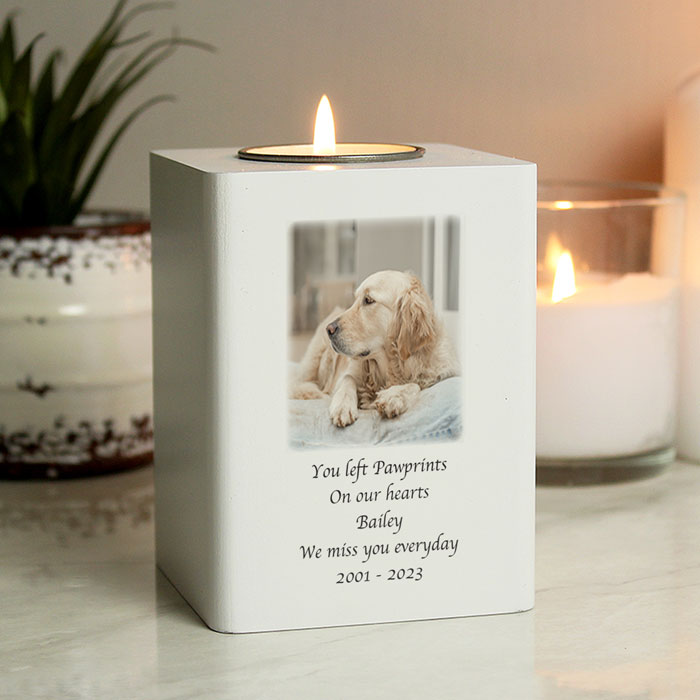
Three of the keepsakes our customers choose most often, as examples of the range rather than a recommendation: the personalised pet photo memorial glass token (there is a cat version too), which is small and simple; the photo LED memorial jar, which lights up in the evening; and the wooden photo tealight holder. Memorial Christmas baubles are popular for the first Christmas after a pet has died; once you have one, it comes out and goes on the tree year after year.

View our personalised pet memorial gifts →
Whatever you choose to remember them by, or whether you choose nothing at all, the photographs and stories are what you will stay with you. We are very sorry for your loss.