
First Holy Communion: What It Is, What Happens on the Day and What to Give
9 March 2012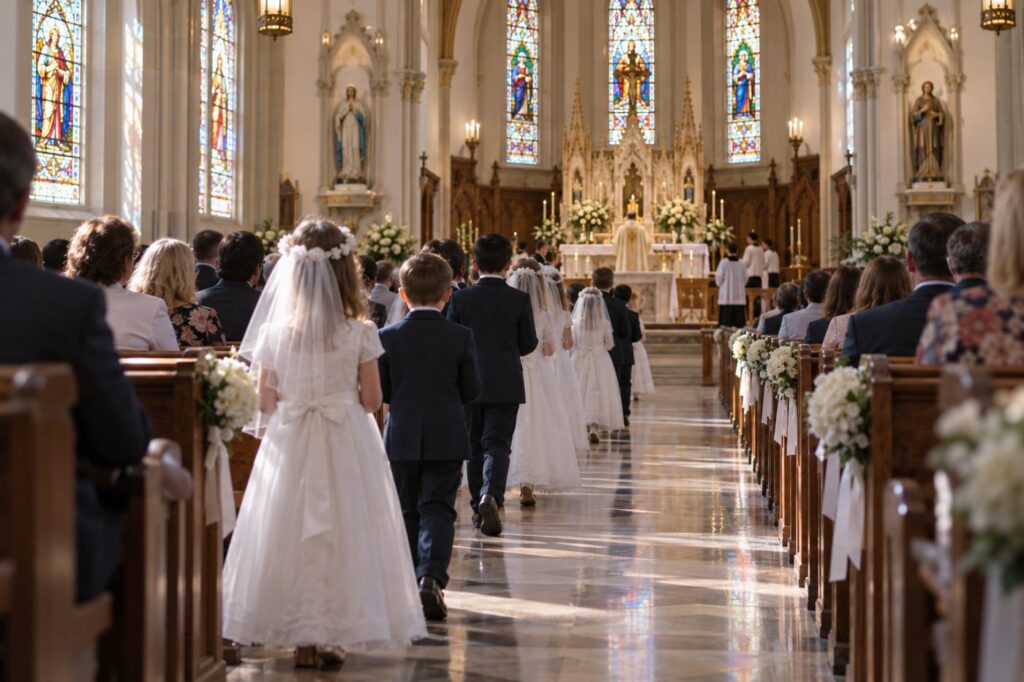
First Holy Communion is the day a Catholic child receives the Eucharist for the first time. It usually happens when they are seven or eight, often alongside other children from their parish, and it is one of the big days of a Catholic childhood: new clothes, a church full of family and usually a celebration afterwards.
We have been selling First Communion gifts since 2003 and first wrote this guide in 2012, mostly because of the questions we were asked. Some came from Catholic families, but many came from godparents, grandparents and friends who had been invited to a First Holy Communion and were not quite sure what it was, what would happen or what to bring. This guide answers those questions: what the ceremony is, what age it happens, what goes on in the Mass and how long it takes, what to wear, and what to give.
What is First Holy Communion?
At every Catholic Mass, the priest consecrates bread and wine, which Catholics believe become the body and blood of Christ. Receiving them is called Holy Communion, or the Eucharist. A child’s First Holy Communion is simply the first time they receive it, and from then on they can receive Communion at Mass like the adults around them.
It is one of the three sacraments of initiation into the Catholic Church, alongside Baptism and Confirmation, which is why it is treated as such a milestone. A child must already have been baptised, and in the Catholic Church they make their first confession (called First Reconciliation) in the months before their First Communion.
Other Christian churches have their own practice. The Church of England, for example, has long confirmed young people first and admitted them to Communion afterwards, although many Anglican parishes now admit baptised children to Communion before Confirmation. If you have been invited to a “first communion” that is not Catholic, ask the family what to expect; most of this guide will still apply.
What age do children make their First Holy Communion?
The Church’s rule is that a child receives Communion once they have reached “the age of reason”, which it has taken to mean about seven since 1910. In England and Wales, parishes and Catholic primary schools usually prepare children in Year 3, so most are seven or eight on the day. In Ireland it is much the same, in second class.
There is some variation. A few parishes prepare children a year later, and children who were baptised later in childhood, or who missed the usual year, join the next group. Adults joining the Catholic Church can also receive their First Communion, often as part of the Easter celebrations. Whatever the age, the preparation is the same: a programme of classes run by the parish, often on Saturdays or after school, which starts in the autumn and runs until the ceremony in the early summer. Parents are expected to come to Mass regularly with their child during that year.
When are First Communions held?
Most First Holy Communions take place between early May and the end of June, with a few running into July. The Mass is usually on a Saturday or a Sunday morning. May is traditional because it is the month of Mary, and because the children have had the whole school year to prepare.
From our side of the counter, that shows up very clearly: First Communion orders start arriving at the beginning of May, and May and June are our two busiest months for Communion gifts, every year without fail. If you have been invited to a Communion in May, the gift is best ordered in April.
What happens at a First Holy Communion Mass?
A First Communion Mass is a Catholic Mass with the children at the centre of the celebration. They usually receive Communion together as a group, so there may be anything from a handful of children to thirty or more. Here is roughly how the morning goes.
- Arriving. Families are asked to be in their seats well before the start, often fifteen to thirty minutes early. Each child’s family usually has a reserved pew, and the number of seats per family is often limited, so check with the parents before you bring the whole street.
- The procession. The children come in together at the start, girls in white and boys in suits, and sit at the front.
- The Mass. Readings, hymns, a short homily, and the bidding prayers, which the children often read themselves. In many parishes the children also bring up the bread and wine at the offertory.
- Communion. The children receive first, one at a time, usually with their parents standing beside them. Depending on the parish, they may receive the host alone or both the host and the chalice. Then everyone else comes forward.
- If you are not Catholic, you are very welcome at the Mass, but you should not receive Communion. You can simply stay in your seat. Some parishes also welcome visitors forward for a blessing, so check with the family if you are unsure.
- Afterwards. A group photograph on the church steps, lots of individual photographs, and then the party.
How long does a First Holy Communion last?
Allow about an hour for the Mass itself, and up to an hour and a half if the class is large or there is a lot of music. Add half an hour for photographs afterwards. If you have a lunch booked, do not book it for the minute the Mass is due to end.
Do you need a candle?
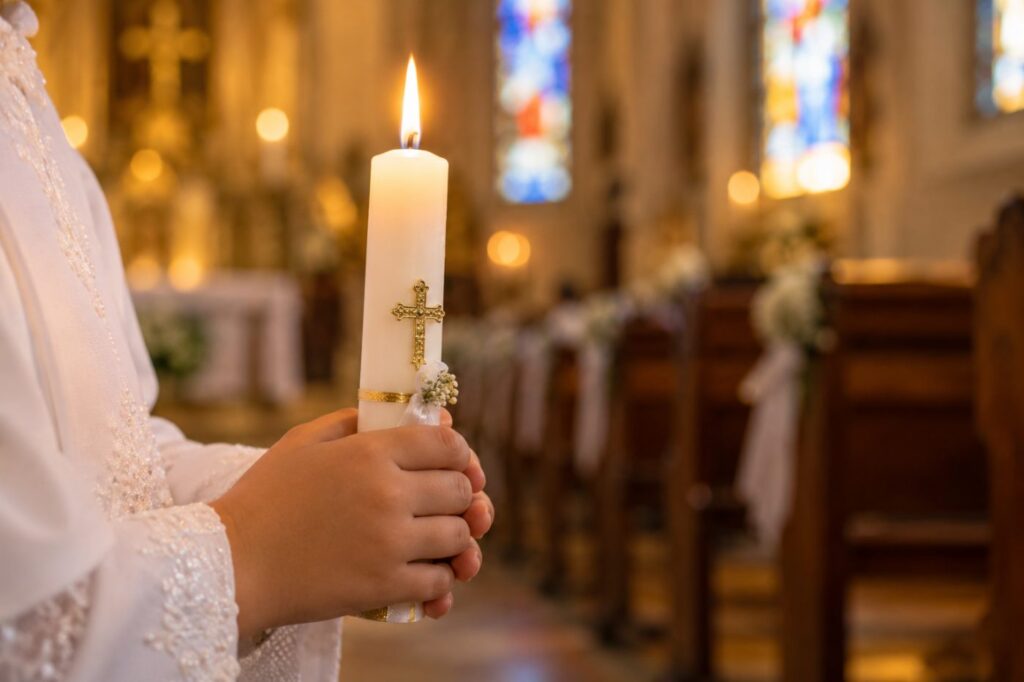
It depends on the parish. Some include candles in the First Communion Mass, sometimes using the candle from the child’s baptism; others do not use them at all. If a candle is needed, a personalised First Communion candle makes a lovely keepsake afterwards. The parish or the catechist will tell you what is required, so it is worth checking before you buy one. We have noticed that Communion candles are not quite as popular as they were a few years ago, which may mean fewer parishes are asking for them.
What to wear
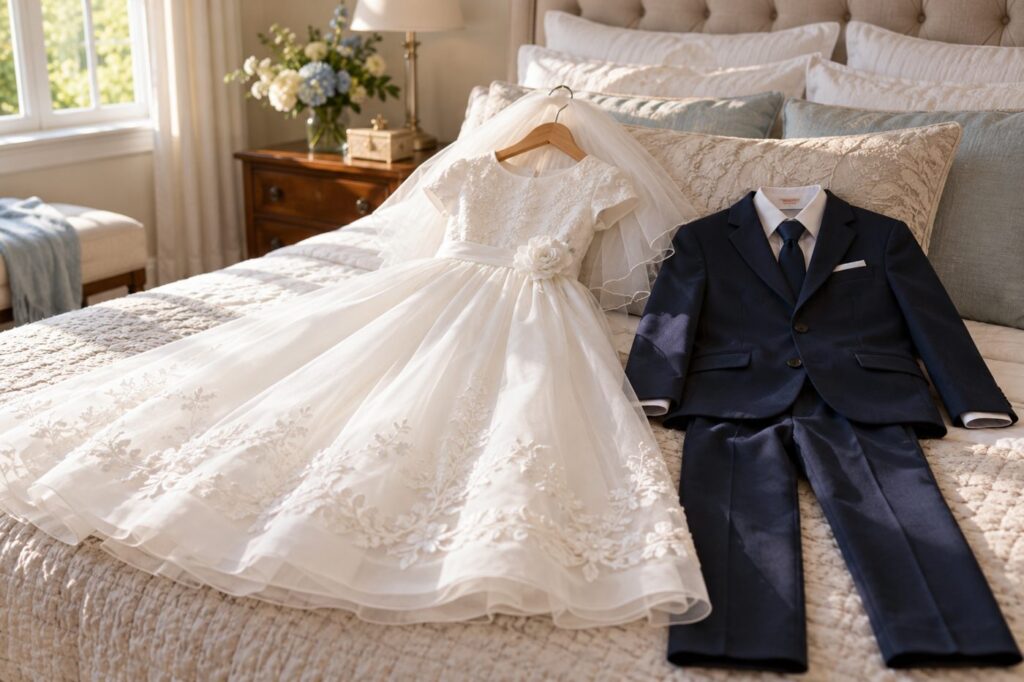
The children are the easy part: girls traditionally wear a white dress and a veil or a flower crown, and boys a suit, or smart trousers with a shirt and tie. Some parishes ask the children to wear school uniform or a white robe over their own clothes instead, so the family will have been told what is expected. Either way, the child will have been looking forward to the outfit for months.
Guests should dress as they would for a smart family occasion in a church: a jacket or a shirt and trousers for men, a dress, or a top and skirt or trousers, for women, and nothing too revealing. You do not need a hat. The main thing is to be comfortable, because you may be in a pew for some time.
Photographs and phones
Every parish has its own rules. Some allow quiet photography from your seat, many ask for no photographs during the Mass, and quite a few arrange a professional photographer or a group picture afterwards so that nobody needs to. Switch your phone off or to silent before you go in, and if you are not sure about photographs, ask the parents. There is always time for pictures outside afterwards, and the light is better anyway.
After the Mass
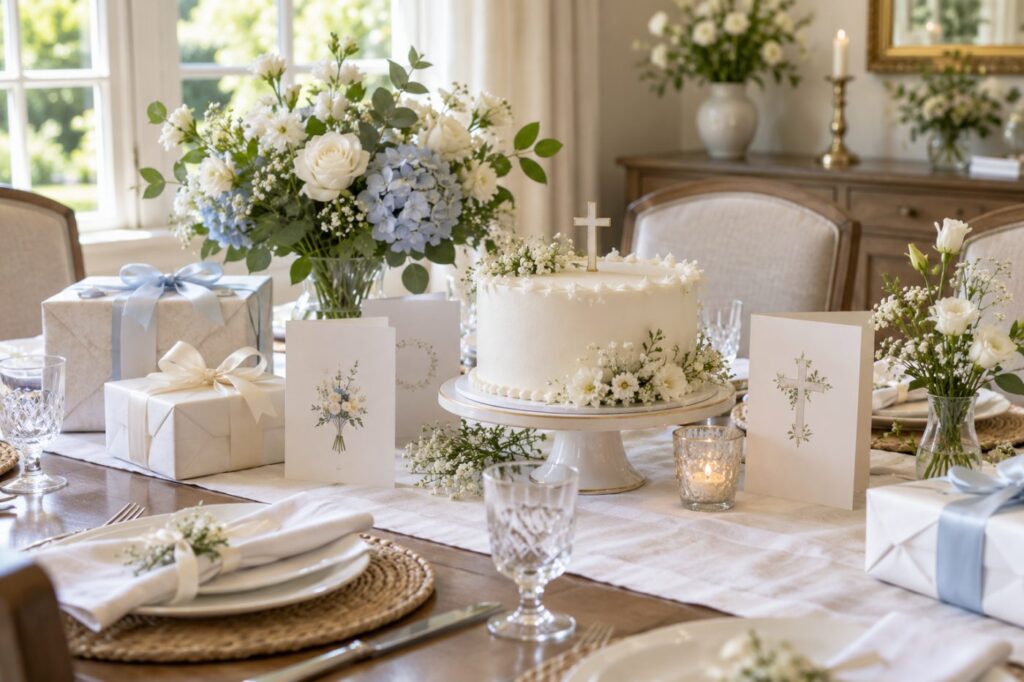
The celebration afterwards is as varied as the families. Some parishes lay on tea and cake in the hall. Many families go on to a meal at home or in a restaurant, and in Ireland and in Irish families here the party can be a serious affair. This is usually when cards and gifts are handed over, so there is no need to bring a present into the church.
First Holy Communion gifts: who gives what
Parents, grandparents and godparents are all likely to be at the Mass, and it is quite normal for each of them to give the child a little something. Family friends and other relatives who have been invited often do too. Twenty years of Communion orders have taught us a few things about what people choose.
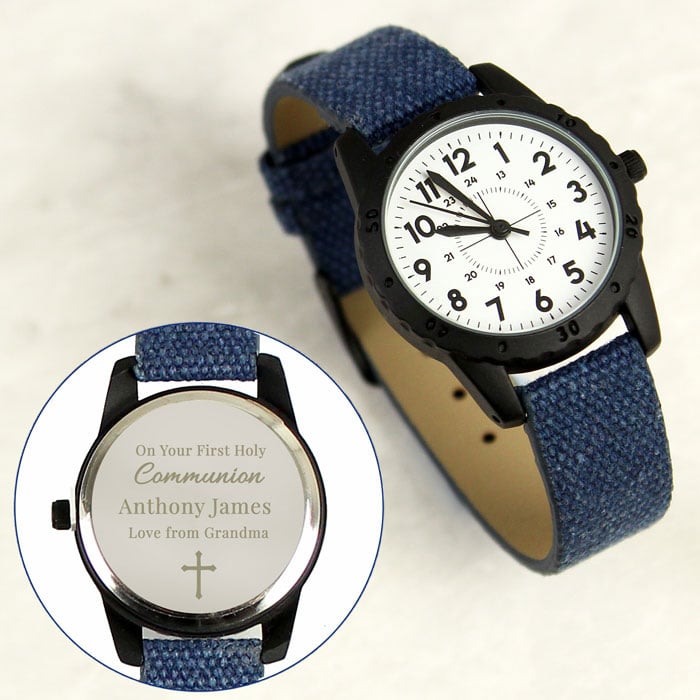
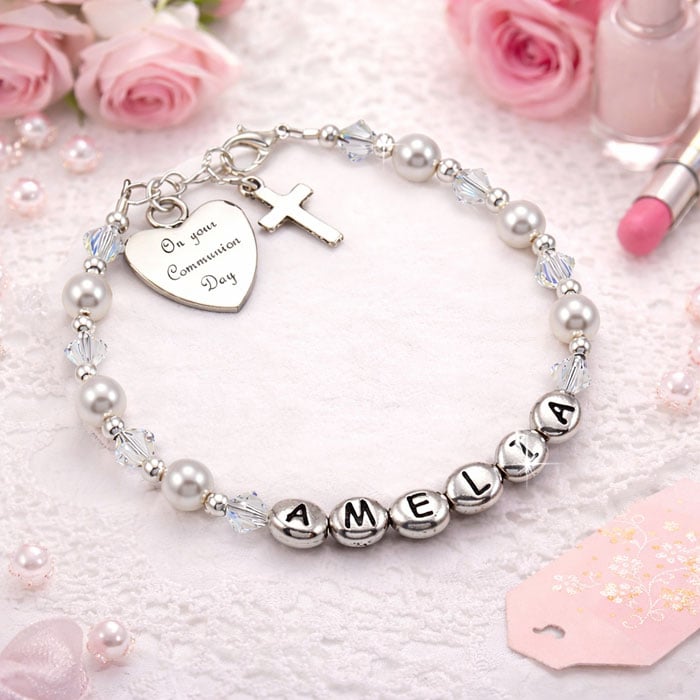
- Grandparents are the most generous. As usual. They tend to go for the keepsake end of the range: a watch engraved with the child’s name and the date for a boy, or a name bracelet for a girl.
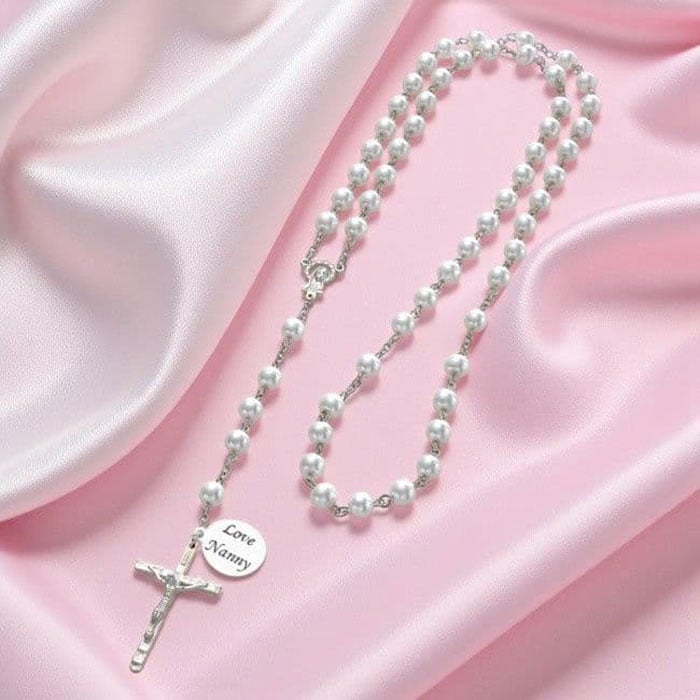
- Godparents choose something with a religious theme. A personalised Bible or a rosary are the favourites, which seems fitting given the godparent’s part in the child’s religious life.
- Boys and girls tend to get different things. For boys, personalised watches have always been popular, and engraved Communion tankards go down very well (for the mantelpiece now, and perhaps for something else at eighteen). For girls, jewellery has traditionally been the favourite: name bracelets, rosaries, cross necklaces. Bibles suit both.
- Money is fine. Some people prefer to give money, especially if they do not know the child well. A personalised money box is a nice way of giving it, and it leaves the child with something to keep afterwards. Most of our customers, though, prefer to buy a present that marks the occasion.
What to have engraved
Keep it simple. The child’s name and the date of their First Holy Communion are usually all that is needed, and on a small item such as a watch or a bracelet they are all that will fit well. If there is room for a short message, a line from a godparent or grandparent is a lovely addition, but there is no need to squeeze the name of the church, the parish priest and the family tree onto a watch back.
Our one piece of advice
Don’t overthink it. Thankfully, we have very few problems with Communion orders, although every year a few customers leave ordering their gift until the very last minute. Personalised gifts take a few days to make, so check the delivery estimate on the product page (it allows for the personalisation) and order with time to spare. We offer a faster service for anyone who has left it late, but ordering in April for a May Communion is the calm way to do it.
Beyond that, your being there matters a good deal more to the child than what you spend. A small gift, made personal, is plenty.
View our First Holy Communion gifts →
What comes next
First Holy Communion is the second of the three sacraments of initiation. The first was the child’s christening, and the third is Confirmation, which in England and Wales usually comes in the early teens. Our guides to both cover what happens and what to give. In the meantime, enjoy the day: the children have worked towards it for a year, and it is one they will remember.