
How to Plan a Christening: Church, Godparents, Gifts and the Party
9 February 2008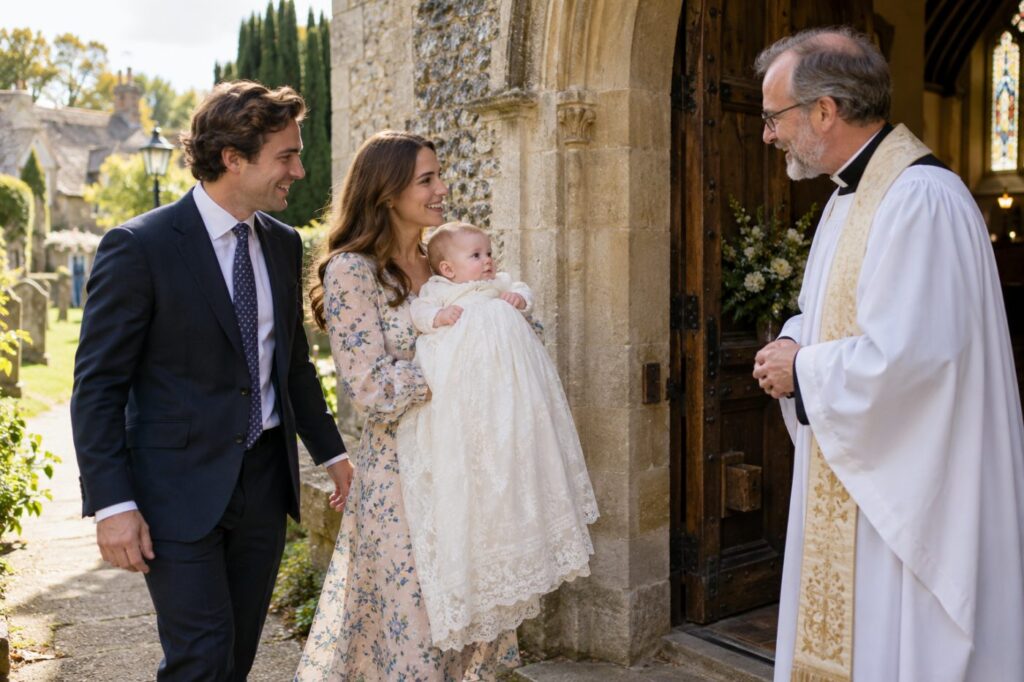
Whether you are organising your child’s christening or have just been invited to one, there is a lot to think about: what to say to the vicar, who to ask to be a godparent, what everyone should wear, what happens afterwards and what on earth you give a baby who already has more teddies than a toy shop. We’ve been selling personalised christening gifts at Born Gifted since 2003, so we’ve picked up a fair bit of knowledge about the occasion along the way. Here’s our guide to planning a christening, what happens on the day and a few things worth knowing before you start.
If you are still not sure what a christening is, or how it differs from a First Holy Communion or a confirmation, our guide to christening, communion and confirmation explains the ceremonies. This one is about the planning.
Christening or baptism?
They are the same thing, and it is the question we are asked more than any other. Baptism is the religious act, the water and the promises; christening is the everyday name for the service, from the old sense of giving a child their Christian name. Vicars and priests tend to say baptism, families tend to say christening, and the invitation may say either. Your child’s name, by the way, is given when you register the birth, not at the font.
Arranging a christening
Speak to the church first
Our number-one tip for parents: before you book a venue, order a cake or buy a single balloon, talk to your local church. Do not assume you can simply pick a Sunday. Churches have their own available dates, other bookings, and in some cases preparation sessions that parents are asked to attend first. The vicar or priest will tell you what is involved, what they need from you and whether there is anything you should know. Sort the church out first, then get carried away with the party.
Who can be christened?
In the Church of England, anyone. You do not need to be married, a regular churchgoer or christened yourself; you simply need to be willing to make the promises and to bring your child up knowing about the Christian faith. Your parish church is the natural place to ask, although many churches will also consider families from outside the parish. Catholic parishes generally have more specific requirements. Parents will normally be asked about their faith and how they intend to bring up the child, and there may be preparation sessions to attend before the baptism can be arranged. It is best to speak to the parish priest well in advance.
How old should the baby be?
Most christenings happen in the first year, but there is no rule and no upper age limit. Plenty of families wait until a child is a toddler, or older, and an older child can be involved in the promises themselves. Our guide to later christenings covers that in more detail.
Which day, and how long does it take?
Church of England christenings usually take place on a Sunday, either as part of the main morning service or at a separate service later in the day, often around midday. Catholic baptisms are often on a Saturday or Sunday afternoon. It varies from parish to parish, so ask rather than assume; a Saturday is not out of the question, but it is the church’s decision.
A separate christening service might take around half an hour, while a baptism included in the regular Sunday service will naturally take longer. The church can tell you roughly how much time to allow. Either way it is a short occasion, which is just as well with a baby.
What does a christening cost?
In the Church of England the service itself is free, although a donation to the church is always welcome. Catholic parishes do not usually set a fee either, but an offering is customary. The real cost of a christening is the party afterwards and the outfits, and that is entirely up to you: a buffet at home with a cake is every bit as traditional as a hired hall.
Choosing godparents
Godparents promise to support the child as they grow up, particularly in their Christian faith. The Church of England normally asks for three godparents, while the Catholic Church generally has one or two, with particular requirements about their faith and religious practice. It is worth checking the rules with your church before asking anyone, especially if the people you have in mind are not regular churchgoers; it saves an awkward conversation later if someone turns out not to meet the church’s requirements.
One thing worth knowing: godparents do not automatically become a child’s legal guardians. If that is something you want, it has to be written into a will, with the godparents’ agreement.
Asking someone to be a godparent is a big compliment, and many parents like to make an occasion of it. We sell personalised gifts for exactly that moment, with messages such as “Will you be my Godmother?” or “Will you be my Godfather?”, and because they are personalised you can write the message in your own words. If you have been asked and are wondering what you have let yourself in for, our guide to what godparents do explains the role.
What happens on the day
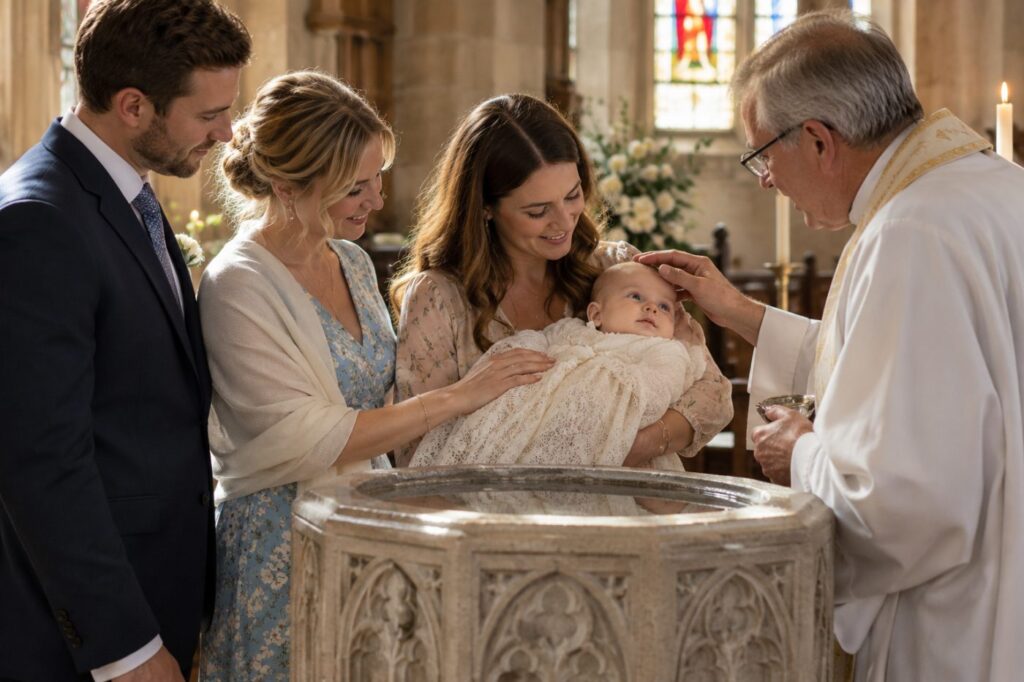
The details differ between churches, but the main parts are much the same. The family and godparents are welcomed, promises are made on the child’s behalf, and the vicar or priest baptises the child with water. There are prayers, and depending on the church there may also be anointing with oil and the presentation of a candle. Nobody expects the baby to behave, and a bit of crying at the font is part of the tradition.
For guests: arrive early
Our number-one tip for guests: allow about twenty minutes before the service starts, particularly if you have never been to that church before. Arriving halfway through, looking for a seat while the entire congregation turns round to watch, is not the entrance you want. If you are not a churchgoer and are unsure whether you are expected to join in with prayers, take communion or anything else, ask the family beforehand; nobody minds, and it saves worrying on the day.
What to wear
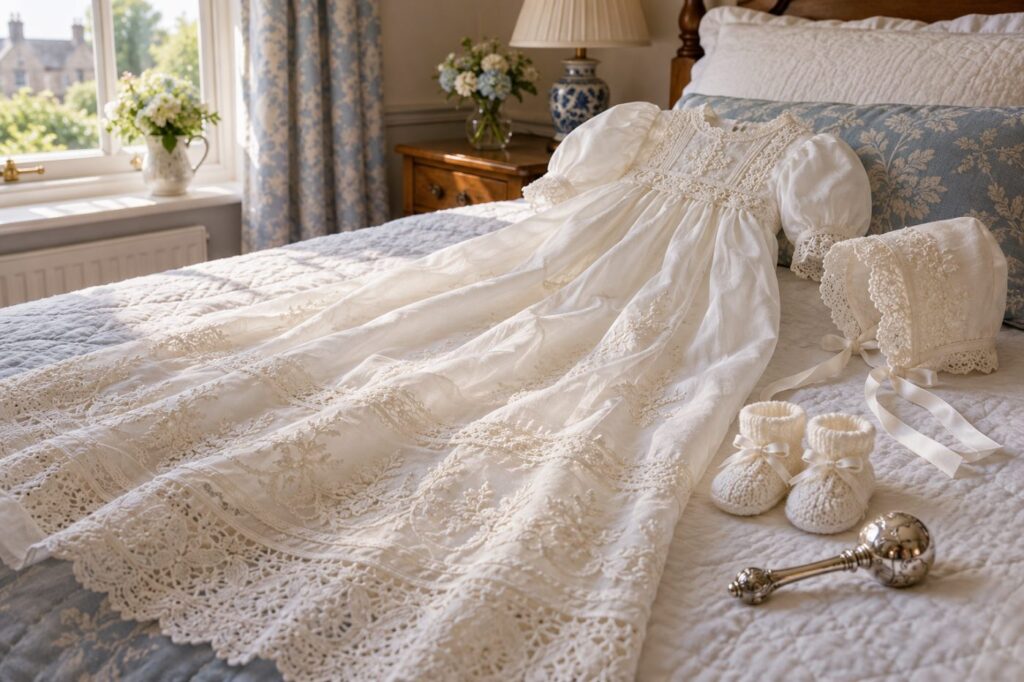
Traditionally the baby wears a long white christening gown, and in some families the same gown has been passed down for generations, which is a lovely tradition if you have one. It is not compulsory, though. A smart white or pale outfit is perfectly acceptable, and the church will not mind what the baby is wearing. For guests, think smart rather than formal: a nice dress or a jacket and trousers is right, hats are not expected and ties are optional. Comfortable shoes are worth considering if there is a party afterwards.
Photographs
Some churches are happy for photographs to be taken during the service, while others prefer you to wait until afterwards. Check with the vicar or priest beforehand so everyone knows what is allowed, and there is always time on the steps afterwards. A quiet word with the photographer, even if the photographer is Uncle Dave with his phone, saves a lot of flashing during the prayers.
The party afterwards
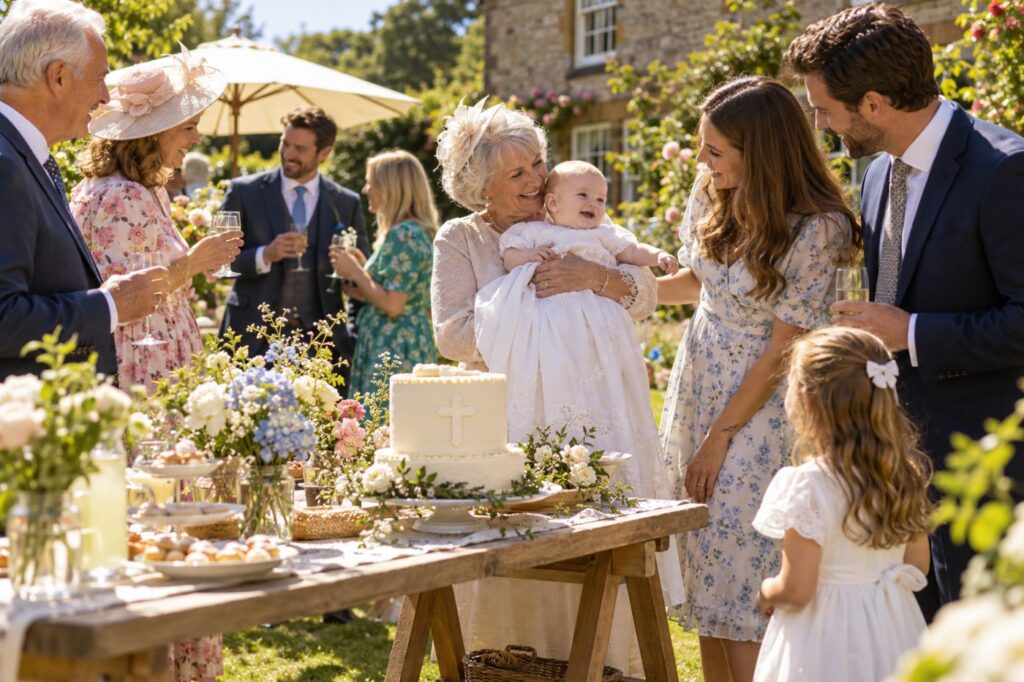
After the service most families gather for food, a cake and a chance for everyone to meet the baby, whether that is at home, in the church hall or at a pub or hotel. And if you would like to invite the vicar or priest to the celebration afterwards, there is certainly no harm in asking. If presents are brought along, it is usual to open them later rather than in front of everyone, and to thank people afterwards.
Two ideas that work well at a christening party. A personalised christening guest book turns a signature list into something worth keeping: ask godparents, grandparents and close family to write a short message to the child, and in years to come they will have a page of words from the people who were there on a day they cannot remember. And a christening keepsake box gives all the small things from the day, the cards, the order of service, a few photographs and perhaps the candle, somewhere to live other than a drawer.
Christening gifts: who gives what
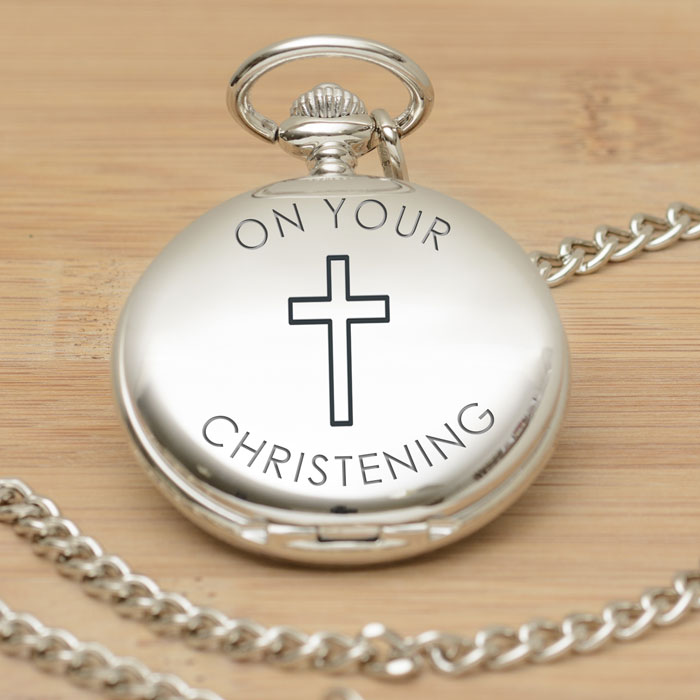
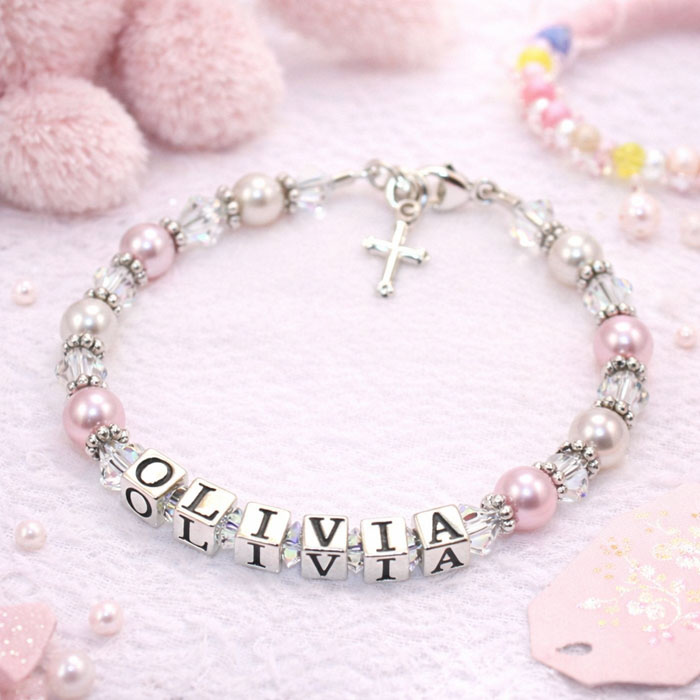
This is the part we know best, and after more than twenty years the pattern is fairly clear. Godparents are our biggest group of buyers, and they are often remarkably generous; they usually want something with a religious connection, such as a personalised Bible or a traditional christening keepsake. Some godparents certainly are not afraid to splash out: we even sell a large wooden Noah’s Ark for around £130, which gives you an idea of what some people are prepared to spend. Grandparents are enthusiastic buyers too, and lean towards traditional keepsakes: engraved money boxes and silver gifts. Parents sometimes buy a keepsake for their own child, such as a pocket watch, cufflinks, a bracelet or a necklace, to be kept for when they are older.
Our best sellers are personalised Bibles, for boys and girls alike, engraved pocket watches for boys and personalised name bracelets for girls. With a baby, of course, a watch or a bracelet is a keepsake to be put away safely rather than something to wear on the day.
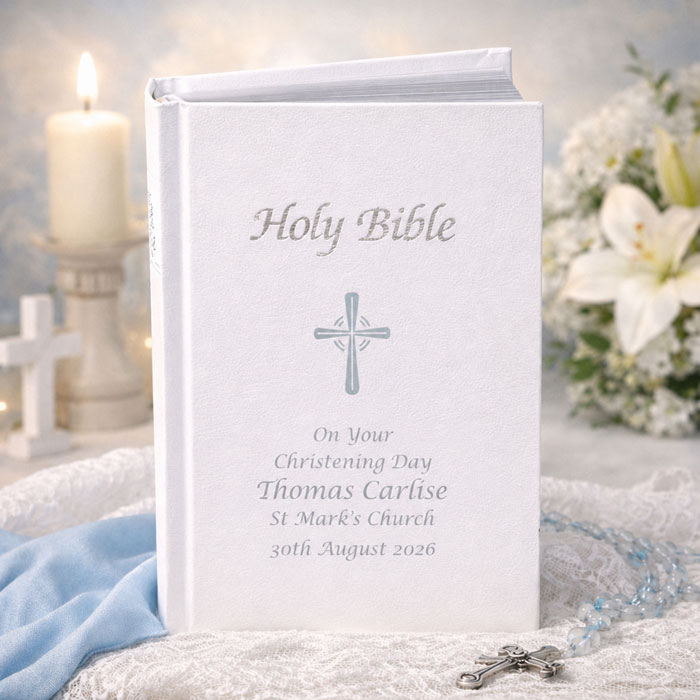
A personalised christening Bible is the classic godparent’s gift, and it suits either a boy or a girl; our guide to the different types of Bible helps with choosing one. For a boy, an engraved christening pocket watch is a traditional keepsake he will appreciate as a teenager far more than as a baby. For a girl, a silver and pearl name bracelet is one of our most popular choices; it is a keepsake for later, not a toy, and should never be left with a baby. You will find all of these and plenty more among our personalised christening gifts.
Is it all right to give money?
Of course it is, particularly if that is what the family would prefer. We do not get many customers asking about giving money, although running a gift shop probably makes us a little biased. Most of the customers we see prefer to buy something the child can keep, but there is nothing wrong with giving money instead. On the card itself, keep it simple. A few personal words wishing the child and the family well are exactly right, and the message does not have to be religious unless you want it to be.
What to have engraved
The child’s name and the date of the christening are the two details nearly everyone wants. “On Your Christening”, then the name and the date, works on almost any keepsake, and if there is room a short line from the godparents or grandparents makes it personal. Two bits of advice from the engraving side of the business. First, go easy on capital letters: many personalised gifts use script or decorative lettering, and a message typed entirely in capitals can be hard to read. Our bestselling white Bible, for instance, takes five lines of up to twenty characters in a script font, and the product page asks for normal capitalisation for exactly that reason. Use ordinary capitals unless the product says otherwise, and check the preview if there is one. Second, read the name and the date back before you order. Once a gift has been engraved, a mistake is not easy to put right.
When to order
Christening customers are, on the whole, an organised lot: about two weeks before the ceremony is typical. There are always a few who leave it to the last minute, and for them we offer an expedited service on some products, which is popular with the less well organised. What is available, and the cut-off times, vary from product to product, so check the delivery information on the product page before you rely on it. Our advice, as ever, is to order in good time; it is one less thing to think about in the week of the christening.
Thank-you gifts for godparents
Giving the godparents a small present to thank them for taking on the role is a lovely tradition, and an extremely popular one with our customers. The gift usually comes from the child and the parents, with wording along the lines of “Thank you for being my Godmother” or “Thank you for being my Godfather”, and it can be anything from a small token to something more substantial. Our personalised godparent gifts cover both ends. It is a thoughtful gesture, not an obligation; nobody becomes a godparent for the presents.
If a christening is not right for you
Not every family feels ready to have their child baptised, and there are other ways to celebrate a new arrival. The Church of England offers a service of thanksgiving for the gift of a child, with no promises made on the baby’s behalf, so that they can decide about baptism for themselves when they are older. Some parents choose a blessing for the same reason. And if you would rather have no religious element at all, a naming ceremony welcomes a baby in front of family and friends, usually with a celebrant and sometimes with guideparents instead of godparents. Our guide to naming day ceremonies explains how they work.
Whatever you decide, our advice is to get the arrangements sorted early, particularly if you are planning a church christening. Then you can concentrate on enjoying the day with family and friends. And do not worry if the baby cries through half the service; they will not be the first, and they certainly will not be the last.