
Confirmation: What Happens, Who Can Be Confirmed and What to Give
16 May 2018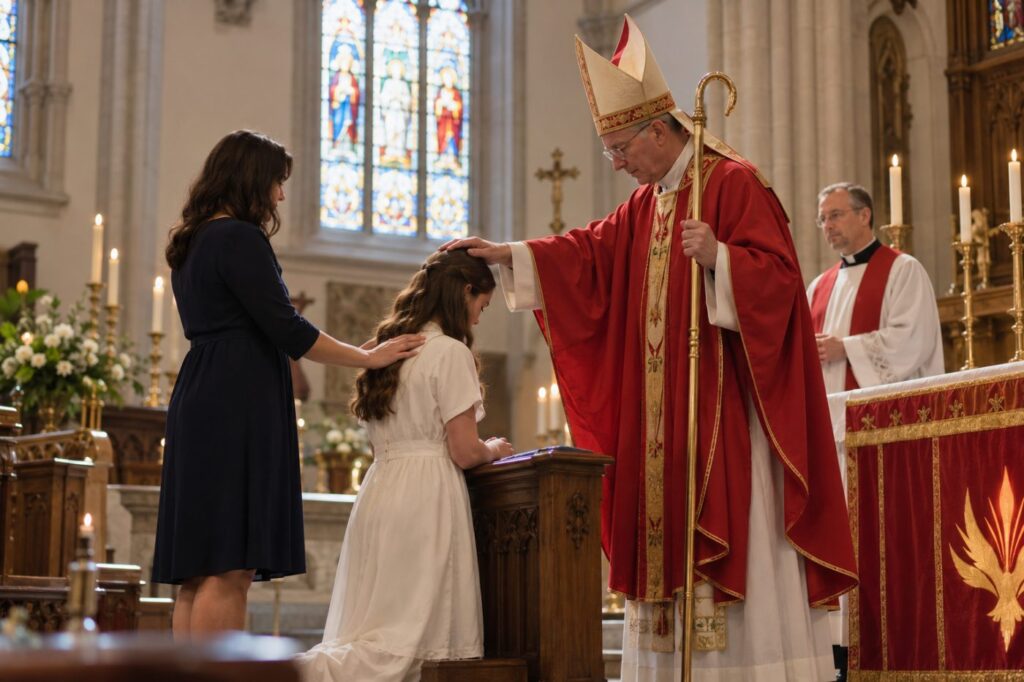
If your son or daughter is about to be confirmed, or you have been invited to a confirmation and are not quite sure what it involves, this guide covers the practical questions: what confirmation is, who can be confirmed and at what age, what happens in the service, how long it takes, what a sponsor does, what to wear and what to give. We sell personalised confirmation gifts, so the last part draws on what our customers actually buy and ask us about. For the church side of things we have stuck to what the churches themselves say, and your own parish is always the final word.
If you want the differences between a christening, a First Holy Communion and a confirmation in one place, our guide to christening, communion and confirmation covers all three. This one is about confirmation on its own.
What is confirmation?
When a baby is christened, the parents and godparents make promises on the child’s behalf. Confirmation is the point at which the person, now old enough to speak for themselves, confirms those promises in their own words in front of the bishop and the congregation. The Church of England describes it in just those terms: you “confirm the promises that were made when you were baptised”.
In the Catholic Church, confirmation is one of the seven sacraments and completes what baptism began. The emphasis is on receiving the gift of the Holy Spirit, which is why the candidate is anointed with holy oil, called chrism, and told to “be sealed with the Gift of the Holy Spirit”. The Catechism lists seven gifts of the Spirit: wisdom, understanding, counsel, fortitude, knowledge, piety and fear of the Lord.
Both churches see confirmation as an important step in Christian life, with prayer for the Holy Spirit at its centre, but they explain its significance and celebrate it in somewhat different ways. Most other Christian denominations have a confirmation or something like it, with their own practice, so if the service is at a Methodist, Church in Wales or other church, ask the minister what to expect.
Who can be confirmed, and at what age?
Anyone who has been baptised can be confirmed. If you were never christened, you can be baptised and confirmed in the same service, or baptised a little beforehand. Confirmation happens once, so if you were confirmed as a child you would not normally be confirmed again as an adult.
The age varies more than people expect, and the old rule of thumb that “confirmation is at fourteen” is only true in some places:
- Church of England: there is no set age. The Church’s own guidance says that someone over ten who can answer for themselves could be ready, and some dioceses set a minimum age, so ask your vicar. Candidates in their early teens are common, but so are adults.
- Catholic Church in England and Wales: the usual age depends on the diocese. In many areas children are confirmed during secondary school, while some Catholic communities follow the “restored order”, with confirmation before First Holy Communion. Your parish will explain the arrangements and the preparation required.
- Ireland: children are traditionally confirmed towards the end of primary school, at around eleven or twelve, and it is a big family occasion. We see the same importance placed on it in orders from Northern Ireland.
- Adults: confirmation is not only for children. Adults who were christened as babies but never confirmed, people who have come to faith later in life and adults joining the Church are all confirmed, often with a short course of preparation first. Among our customers, orders for adults being confirmed are not at all unusual.
Whatever the age, there is usually some preparation: a few sessions with the vicar or priest, or a course run through a Catholic school or parish. There may be a rehearsal the week before.
Where does confirmation come from?
The practice goes back to the earliest church. The Acts of the Apostles describes Peter and John travelling to Samaria to pray and lay hands on new believers who had been baptised but had “not yet received the Holy Spirit” (Acts 8:14-17). The laying on of hands in that passage is the heart of the confirmation service to this day; the anointing with oil came in alongside it in the early centuries. Catholic and Anglican confirmation grew apart at the Reformation, which is why the two services look slightly different now while doing the same thing.
Who does the confirming?
Normally a bishop. In the Church of England it is the bishop who lays hands on each candidate, which is why confirmations are often held for several parishes at once, in a parish church or at the cathedral, on a date set by the bishop’s diary. In the Catholic Church the bishop is also the usual minister, although a priest may conduct a confirmation in certain circumstances, including when authorised to do so. A vicar or priest does not simply confirm whenever they like, so if you are asked to attend a service with the bishop, that is why.
What happens in the service
In the Church of England, confirmation takes place within a normal service, often with Holy Communion. There are hymns, readings and sometimes a word from the candidates themselves. The candidates renew the promises made at their baptism, the bishop prays over them and then lays his or her hands on each person’s head in turn with a short prayer. The newly confirmed may take communion at that service; in the Church of England you do not have to be confirmed to receive communion, and some children are admitted to communion before they are confirmed.
In the Catholic Church, confirmation usually takes place within a Mass, after the Gospel and the homily. The candidates renew their baptismal promises and the bishop extends his hands over them and prays for the Holy Spirit. Each candidate then comes forward with their sponsor, who places a right hand on the candidate’s shoulder and gives their name to the bishop. The bishop traces a cross on the candidate’s forehead with chrism and says “Name, be sealed with the Gift of the Holy Spirit”, to which the candidate answers “Amen”; the bishop then says “Peace be with you” and the candidate replies “And with your spirit”. The Mass then continues with the Eucharist. Depending on the local arrangements, the candidates may already have made their First Holy Communion, or confirmation and First Communion may be celebrated together.
Confirmation names. In many Catholic parishes candidates choose a saint’s name for confirmation, and it is the name the bishop uses at the anointing, although some keep their baptismal name. The parish will explain its practice. If the person has chosen a confirmation name, it can also make a good addition to a personalised gift (more on that below).
How long does a confirmation service last?
Confirmation services are usually longer than an ordinary church service, particularly when there are a lot of candidates, because each one goes up individually. St Paul’s Cathedral, for example, advises allowing around ninety minutes. Catholic confirmation Masses can also take longer than a normal Sunday Mass, depending on the number of people being confirmed. If you are organising a celebration afterwards, ask the church how long to allow and leave some extra time for photographs.
What does a confirmation sponsor do?
A sponsor stands with the candidate at the confirmation, presents them to the bishop and, in principle, supports them in their faith afterwards. The role is like that of a godparent at a christening, but it is not the same thing and the rules differ between churches:
- Catholic Church: each candidate normally has one sponsor. Under church law the sponsor must be at least sixteen, a confirmed Catholic who has received communion and practises the faith, and not the candidate’s parent. The Church says it is “desirable” for the sponsor to be one of the person’s godparents, which is why a godparent is so often asked. The parish will explain the requirements and any permitted exceptions, so check before formally asking someone to be a sponsor.
- Church of England: there are no godparents at confirmation and a sponsor is optional. If the candidate wants one, it is usually someone who has been confirmed themselves: a youth leader, a relative or a friend from church.
Godparents are welcome at a confirmation whether or not they are the sponsor, and many families invite them. Some sponsors give the candidate a gift, and some families give the sponsor a small thank-you; neither is expected, and a card and a place at the table afterwards is thanks enough for most people.
What to wear
Smart but not formal is the safe answer. Candidates usually wear what they would for a smart family occasion: a shirt and trousers or a suit for boys, a dress or a smart top and skirt or trousers for girls. There is no requirement for white, although some Catholic parishes and schools in Ireland and elsewhere have their own customs, and a few give out dress guidance, so ask before you buy anything special. Guests should dress as they would for a smart family occasion: nothing you would be uncomfortable sitting in for a couple of hours. If the confirmation is at the cathedral, remember that it may be cool inside whatever the weather.
After the service
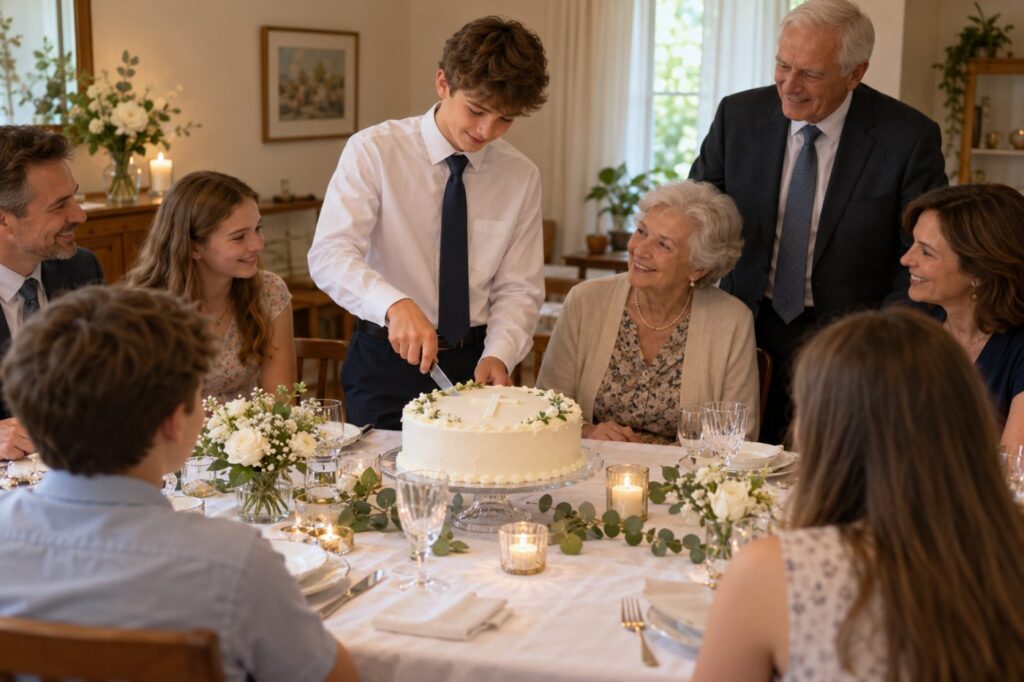
How much of an occasion the family makes of it varies. For some it is a quiet lunch with the grandparents and the sponsor; for others, particularly in Irish and Catholic families, it is a proper celebration with a cake and the wider family round. Some parishes put on tea and coffee straight after the service, which is a good moment for the photographs. Some families invite the sponsor and godparents to join them for a meal afterwards, particularly if they have travelled to attend.
Confirmation gifts
Parents, grandparents and godparents are the main people buying confirmation presents from us. Sponsors sometimes give a gift too, although there is no obligation, and other guests are not expected to. These are the gifts our customers choose most often at the moment.
For boys, two of our bestsellers are the personalised confirmation pen and box set and the personalised brass travellers compass in a wooden box. The pen set is a practical keepsake for a child who is getting a bit older, with the box engraved rather than the pen, so the message stays even if the pen goes missing. The compass is the more unusual choice: a solid brass compass in a mahogany box, with a message engraved round the compass itself, and it is one of our most-reviewed keepsakes, bought for christenings and communions as well as confirmations.
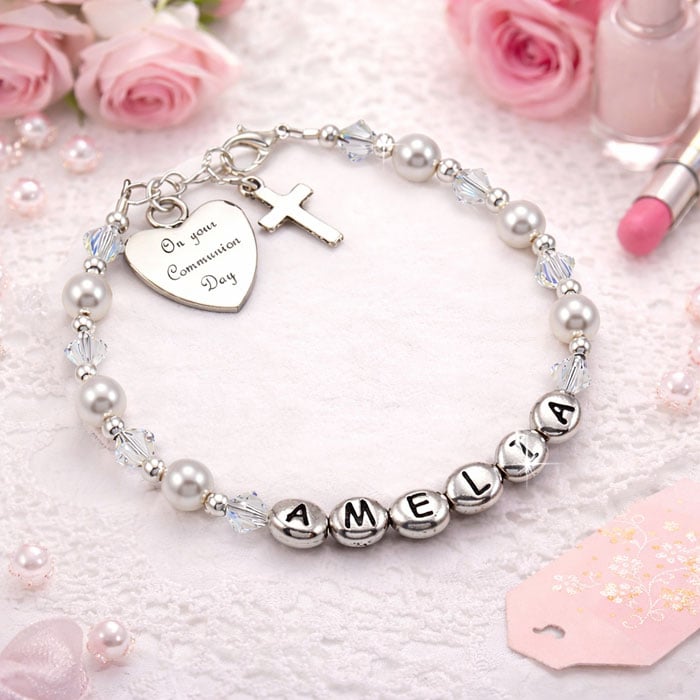
For girls, jewellery is always popular, and the girl’s personalised confirmation name bracelet is a favourite: pearls and crystals, her name in rhodium-plated letter beads and a small heart engraved on both sides, in sizes from toddler to adult. The personalised engraved Bible trinket box is the other one we would mention, a silver-plated box shaped like a Bible with a cross on the cover, engraved on the front and lined inside for rosary beads or jewellery.
None of these is strictly a boy’s or a girl’s gift. The pen set, the compass and the trinket box suit anyone. As a rough guide, Catholic customers tend to choose gifts with an obvious religious element, such as a rosary, a cross necklace or the Bible trinket box, while Church of England customers lean towards a traditional keepsake such as a watch, a pen or a piece of engraved jewellery. That is a trend we have noticed over the years, not a rule, and the best guide is the person being confirmed.
For adults being confirmed, think a step up from the children’s gifts. A personalised Bible is the classic choice and remains a popular one. For a man, the brass compass makes a grown-up keepsake that a personalised message can tie to the day without the gift itself looking religious; for a woman, a piece of engraved jewellery or a trinket box does the same job. What suits an eleven-year-old is not always right for someone being confirmed at forty.

A confirmation gift does not need to be expensive or even particularly religious. Choose something the person will keep and appreciate, and let the engraving carry the occasion.
What to engrave
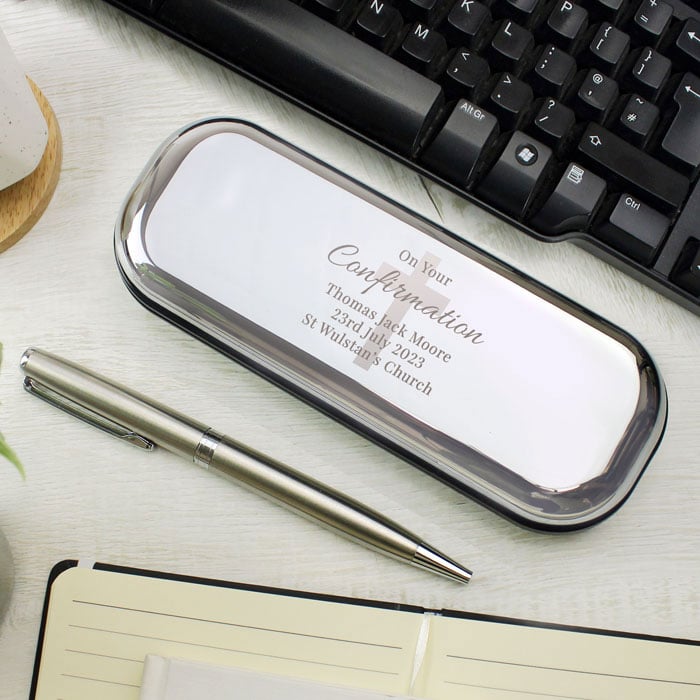
The wording we see most often is simple: “On Your Confirmation” or just “Confirmation”, followed by the name and the date. Where there is room, some customers add the name of the church. We do not often see the chosen saint’s name included, but if the person has taken one, adding it is a nice touch, for instance “On Your Confirmation, Hannah Teresa, St Mary’s, 10 May 2027”.
Our advice, from years of seeing what works, is to keep it simple rather than filling every line you are offered. “On Your Confirmation, Daniel. With love from Grandma and Grandad” means more than a long verse that barely fits. Two practical points. First, some decorative script fonts can be difficult to read in all capitals: the first line of our Bible trinket box, for example, is engraved in a script font and the product page asks you to avoid all uppercase for that reason, so follow the instructions on each product and use normal capitalisation unless they say otherwise. Second, check the spelling of names, the date and the church before you order; personalised gifts are made to order and a slip is hard to put right afterwards.
When to order
Most of our confirmation customers order a couple of weeks before the service, much as they do for christenings. We offer faster production and delivery on some products, but the cut-off times vary, so check the delivery estimate on the product page and allow a little extra for anything personalised. Confirmation orders tend to be busiest in spring and early summer, so it is worth allowing a little extra time where possible.
Confirmation gifts from Born Gifted
You can see the full range of personalised confirmation gifts, which can be filtered for boys, girls and by price, and if you are a godparent looking for something for the day, our guide to what godparents do and our guide to the different types of Bible may help.