
Guide to Naming Day Ceremonies: What Happens, Who Leads It and Gift Ideas
6 November 2012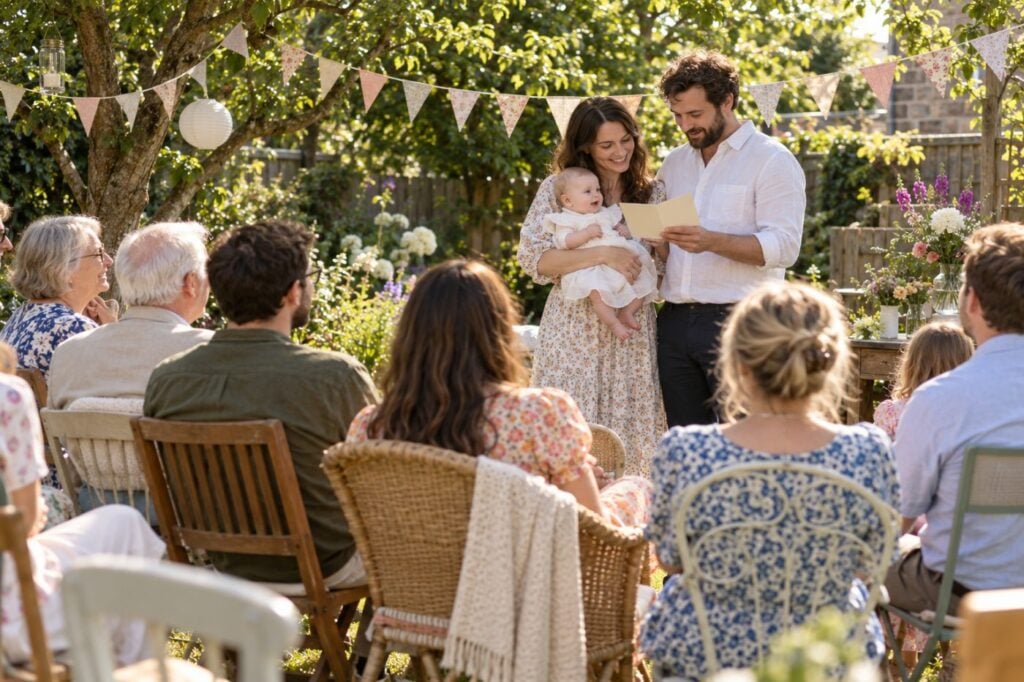
A naming day, or naming ceremony, is a non-religious way to welcome a child into the family and to introduce them, by name, to the people who will matter in their life. There is no church service, no set form of words and no requirement to hire a celebrant. Parents can say a few words about their child, invite family or friends to make promises, and perhaps sign a commemorative certificate. Then there is usually cake. It is the closest thing to a christening for families who do not want a religious ceremony, and one of its great attractions is that nobody has to be anything, do anything or employ anybody. This guide explains what happens, who can lead it, what guideparents are, how it differs from a christening and what it does and does not do legally.
What is a naming day?
It is a celebration, not a sacrament and not a legal event. The parents have already chosen their child’s name, which is recorded when the birth is registered; a naming ceremony is a celebration of that name, not a legal procedure. What a naming day does is gather the people who love the child, announce the name and why it was chosen, and let the parents, and anyone else they invite to, make promises about the kind of family and the kind of support the child will have. It can be as formal as a wedding reception or as informal as a Sunday afternoon in the garden with a few words before the sandwiches.
How is it different from a christening?
A christening, or baptism, is a religious service with a set liturgy, led by a vicar or priest in a church, in which godparents make specific Christian promises. Our christening guide and our guide to religious ceremonies cover all that. A naming day has none of those fixed parts. There are no religious promises, no church rules about who may take part, no set venue and no required number of anything. Families who are not religious choose it for exactly that reason; families of mixed or no faith often find it the easiest way to include everyone, since nobody is asked to say anything they do not believe. Some families do both, a christening and a party, and some hold a naming day for an older child who was never christened.
Do you need a celebrant?
No. A naming ceremony has no legal status, so there is no requirement to have an official celebrant, no licence and no registration. You can organise and lead it yourselves, or ask a confident relative or friend to do it.
If you would like help, there are three kinds of professional:
- Humanist celebrants. Humanists UK trains and accredits celebrants who write a ceremony for your family from scratch, lead it on the day, and give you a presentation copy of the script. The ceremony is non-religious by definition.
- Civil naming ceremonies. Many councils’ register offices offer a naming ceremony led by one of their celebrants, at the register office or an approved venue, for a child of any age; the council sets the fee and the ceremony has no religious content.
- Independent celebrants. Freelance celebrants, many of them also wedding celebrants, will write and lead a naming ceremony, and some will include spiritual or religious elements if you want them (which does not make it a baptism).
Whoever leads it, the content is yours: a good celebrant asks you what you want and writes it, rather than handing you a script.
What happens at a naming ceremony?
There is no fixed order or length. A short ceremony might take twenty or thirty minutes, depending on what you include. Here is one possible running order:
- Welcome: whoever is leading introduces the child and explains why everyone is there.
- The name: the parents announce the child’s full name, and often say why they chose it, who the child is named after, or what the name means.
- The parents’ promises: in their own words, what they hope to give the child. Some couples make promises to each other at the same time.
- Guideparents’ promises: the supporting adults say, together or one by one, what they promise to be for the child.
- Readings and music: a poem, a passage from a favourite children’s book, a song; grandparents and older brothers and sisters are often given this part.
- A symbolic act (optional): planting a tree, sealing a time capsule or memory box with letters to be opened at eighteen, lighting a candle, blending coloured sand, or guests writing a wish for the child on a card.
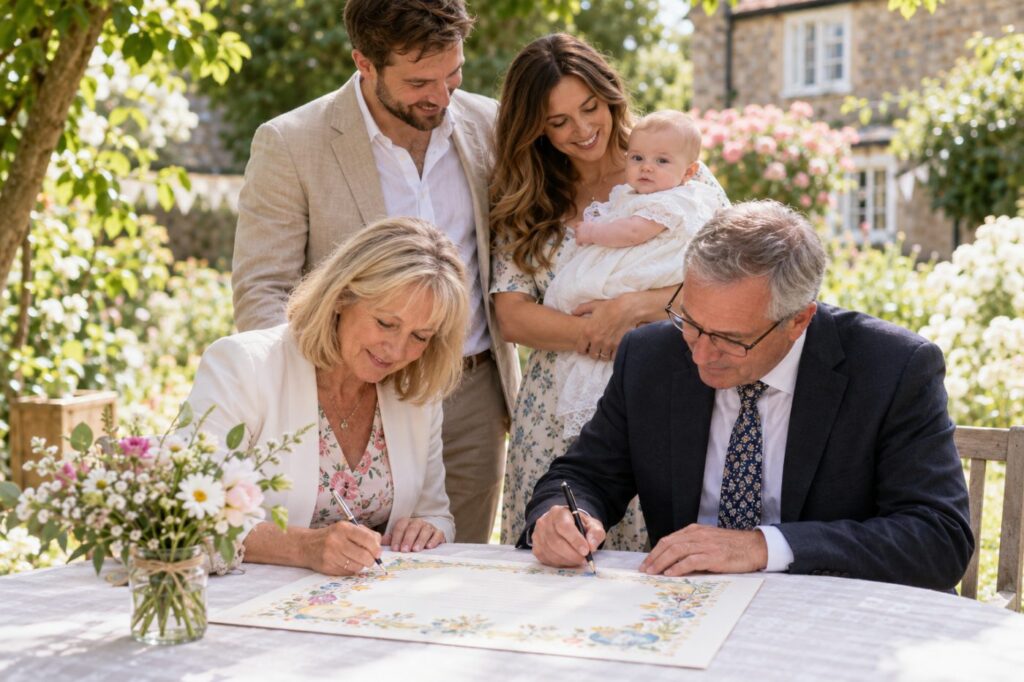
- A commemorative certificate (optional): the parents and guideparents can sign one as a keepsake of the occasion. It has no legal status.
- Closing words, then the party.
Our guide to memory boxes has ideas for the time-capsule version, which is the one children enjoy most when they are old enough to open it.
Choosing guideparents
Guideparents are the non-religious equivalent of godparents: adults the parents choose to take a long-term interest in the child, and who make their own promises at the ceremony. The name is not fixed. “Guideparent” is the one we see most often on our customers’ personalised gifts, and it is the word Humanists UK uses, but families also say sponsor, mentor, supporting adult, honorary aunt and uncle, or simply godparent, which some people keep because everyone understands it (it can confuse guests at a non-religious ceremony, so it is worth saying what you mean). We would be careful with “guardian”: it sounds legal, and it is not, as explained below.
There are no rules about how many guideparents you can have, or whether they must be men or women: one or two close friends, several relatives, or none at all. Choose people who will still be in your child’s life in fifteen years, and ask them well before the day so that they can think about what they want to say. The role is whatever you and they make it: being there, remembering birthdays, being a grown-up the child can talk to who is not a parent. Our godparents guide has more on what godparents and guideparents do, and how the two differ.
Where, when, and for what age?
Anywhere you like: your home or garden, a village hall, a pub function room, a hotel, a park, a beach. Because the ceremony has no legal status, the venue does not need a licence, although a council’s own naming ceremony will be at the register office or one of its approved venues. If you are using a public space or a hired venue, check whether you need permission and whether there are restrictions on decorations, music or the size of the gathering; and think about where the grandparents will sit.
There is no age limit and no deadline. Most naming days are held in the first year or so, but older children have them too, and the ceremony is a natural way to welcome an adopted child, or to mark a step-family coming together, with every child included and making their own promises if they want to. Brothers and sisters can be part of a baby’s ceremony as well: a reading, a drawing, or presenting the first gift.
Combining a naming day with a first birthday
This is very common, and it makes sense: everyone is coming anyway, the food and the cake are organised, and a short ceremony before or after the birthday tea gives the party a centre. Our first birthday guide covers the party side. Two birds with one stone. There is nothing to stop you combining it with a christening party either, or with a summer barbecue that happens to have a certificate in it.

The certificate, and what a naming day does not do
The certificate is a keepsake. It is signed, witnessed and often beautifully made, and it has no legal status at all, which is worth being clear about:
- It does not register the birth. That is a separate legal duty: within 42 days in England, Wales and Northern Ireland, and within 21 days in Scotland. The naming day can be whenever you like afterwards.
- It does not change a name. Changing a registered name is a separate legal process: depending on the child’s age and where they were born, it may mean updating the birth register or making a deed poll, and the consent of the people with parental responsibility may be needed, so check the official guidance for your part of the UK.
- It does not make anyone a guardian. Calling someone a guideparent, sponsor or even “guardian” at a ceremony gives them no legal rights or duties. If you want someone to look after your children should anything happen to you, that is arranged separately, usually in a will, and it is worth taking legal advice.
Promises, readings and what to wear
The promises are the part people worry about writing, and the trick is to keep them short and true. Three or four sentences from each parent is plenty: what you hope for, what you will try to do, perhaps one thing you have already learned about this particular child. Guideparents’ promises can be a single shared sentence (“We promise to be there, to listen, and to take you to the zoo”) or a few words each. If someone would rather not speak, a reading is the kind alternative.
For readings, do not overlook children’s books: a page from a picture book the family already loves can mean as much as a poem, and the children present will recognise it, although a favourite poem works just as well. The music is entirely up to you; choose something that means something to your family.
Dress is whatever the invitation says. A naming day is usually a smart-casual family party rather than a formal occasion, and a baby in a long christening gown is unusual but not wrong. If there is no steer, dress as you would for a daytime family celebration.
Naming day gifts
Guests are not expected to bring a present, and a card with a few personal words can be every bit as meaningful: if the family keeps it, the child may enjoy reading those messages when they are older. That said, most close family and guideparents do give something, and this is where we can be useful, because we have been selling naming day gifts for a long time and see what people choose.
In our experience the people most likely to buy a naming day present are the guideparents, closely followed by the grandparents. Guideparents tend to choose something personalised and lasting: an engraved silver-plated keepsake, a money box or a piece of jewellery, a present that marks the day and that the child can keep as they get older. Grandparents are often prepared to spend a little more on something substantial. Parents seem less likely to buy a naming day gift themselves, perhaps because they are already organising the celebration.
Naming day presents also differ from christening presents. Christening buyers often want something with a religious connection: a Bible, a cross, a traditional silver keepsake. Naming day buyers choose from a much wider field, because there is no religious theme to follow, and the common thread is personalisation rather than religion: teddy bears, engraved money boxes, jewellery, cutlery sets, silver-plated keepsakes, even a tankard to be kept for later. The presents lean towards keepsakes rather than clothes or everyday toys, although a toy the family will actually use is never wrong. When a customer asks us whether a Bible would suit a naming day, we usually suggest something without a religious message instead, but the choice is always the family’s and the giver’s.
Here are three examples of the different sorts of naming day keepsake people choose.
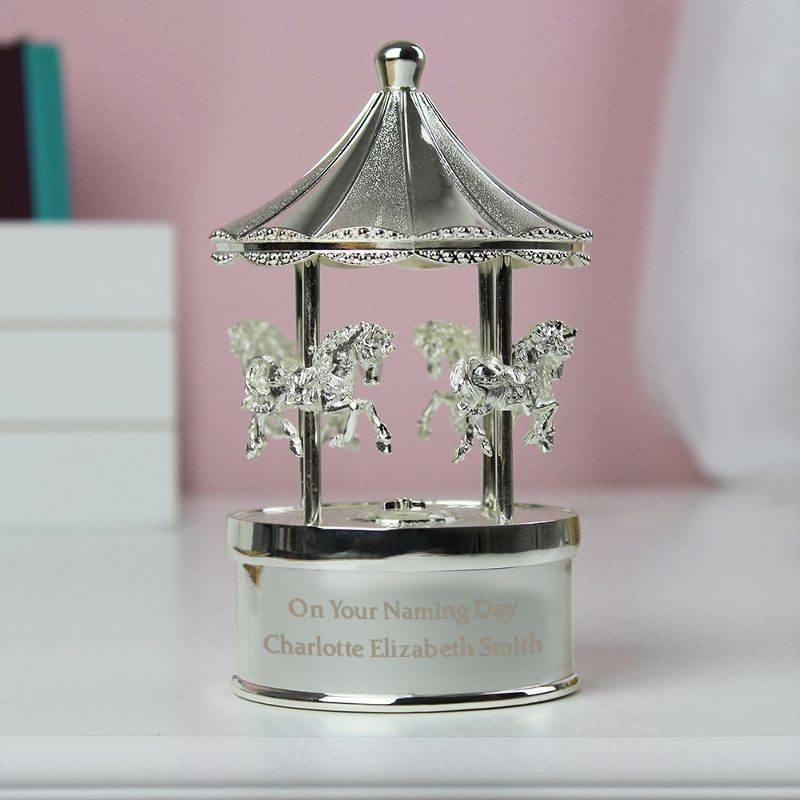
A personalised musical carousel is a traditional silver-plated keepsake, engraved with two lines of your own words, and several customers have bought it for a naming day rather than the christening its listing talks about. It is an ornament for the shelf, not a toy.
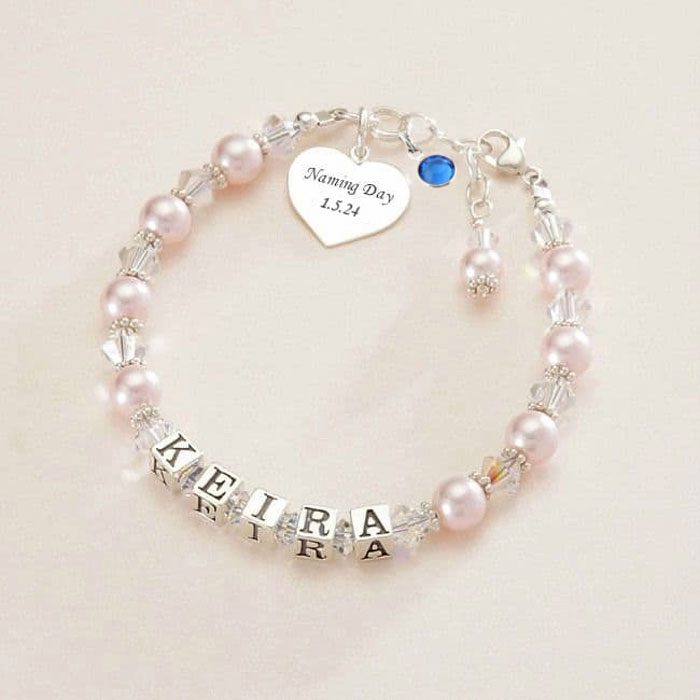
The silver and pearl birthstone naming day bracelet is the jewellery choice: the child’s name in silver letter beads, a birthstone, and a heart engraved with “Naming Day” and the date, with a message on the back. It is a keepsake for the jewellery box, to be worn later, not a toy for a baby to wear or chew.
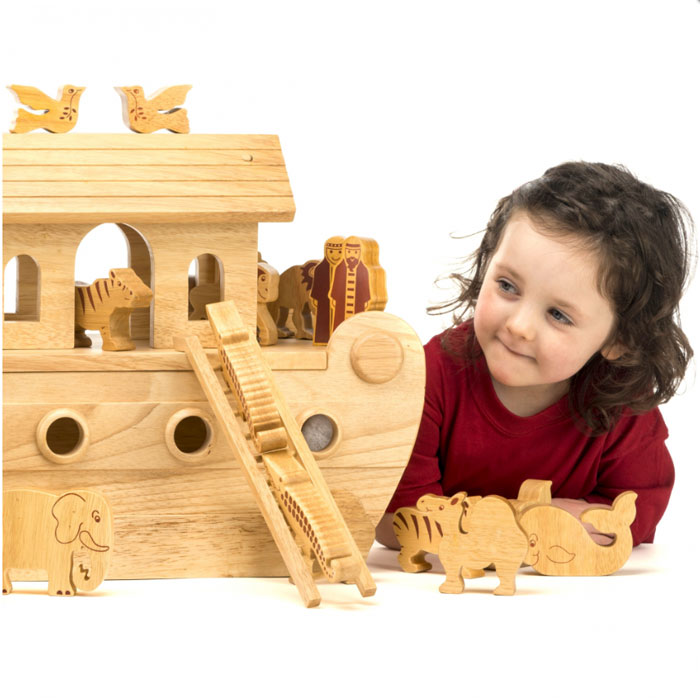
And the Lanka Kade giant wooden Noah’s Ark is the grandparents’ present: a substantial, hand-made wooden playset that can be kept for years and passed down. Noah’s Ark has biblical origins, of course, and some families planning a secular day will prefer something else, while others choose it simply as the classic wooden toy it has become; it is for ages three and over because of small parts, so for a baby’s naming day it is a present to put away for later.
What to have engraved
The child’s name is nearly always the most important part, then the date of the naming day, then a short message from the giver. On a gift with room for several lines, the layout customers choose most often looks like this:
On Your Naming Day
Charlotte Rose
22 May 2027
With love from
Auntie Sue
That is an example for a product with room for five lines; each product has its own number of lines and characters (the carousel, for instance, takes two lines of up to thirty characters), so follow the product page, and check whether the product already carries fixed words such as “Naming Day” (the bracelet’s heart does) so that you do not enter them twice. One more thing to check twice: the date of the naming day is not the date of birth, and they are usually different. Put the one you want remembered.
Our number-one tips
For parents: don’t get too hung up on making it an occasion. You do not need a celebrant, a venue, a set number of guideparents or a long ceremony; if you would like a professional to plan and lead it, that is fine, and if you would rather gather everyone in the garden, say a few words about your child and get on with the buffet and the cake, that is fine too. Make it suit your family rather than someone else’s idea of what it should look like. Just remember that it does not replace registering the birth, and it changes nobody’s name or guardianship.
For guests: please don’t feel you have to spend a fortune. A personalised keepsake is a lovely way to mark the day, but a card with a few words written for the child, kept and read in fifteen years’ time, can mean just as much. Not every special occasion needs an expensive present attached to it.